Implementation Guide
Management Reviews.
A management review is the monthly meeting where site leadership closes the loop between strategy and daily work: KPI exceptions with countermeasures, initiative milestones, escalated problems, and decisions with owners and dates. The test of a management review is its decision log. If a month of reviews produces explanations but no decisions with owners, the review is a reporting ceremony and the real decisions are happening in hallways.
What a management review is for
A management review is the monthly meeting where a site's leadership closes the loop between strategy and daily work. The daily tiers protect today; strategy deployment set the year's targets; the review is where the two meet. It reads the month's KPI exceptions and their countermeasures, checks the milestones of the improvement portfolio, takes the escalations that need authority or money, and converts all of it into decisions with owners and dates.
That last sentence is the whole test. Explanations, charts and status are the inputs of a review; decisions are its only output. A plant can tell within one month which kind of meeting it has, because the evidence is binary: either the decision log has entries with owners, or it does not. When it does not, the review is a reporting ceremony, and the decisions that actually steer the plant are being made in hallways, one-on-ones and email threads, invisibly and without follow-up.
Scope note: this page covers the meeting itself, its inputs, agenda and chairing. The room many mature plants run it in, with strategy, performance, project and problem walls, has its own guide: Obeya. A review does not need an Obeya to work, but an Obeya makes a good review cheaper to prepare, because the walls are the pre-read.
Where it sits in the transformation roadmap
On the TeamGuru deployment roadmap, management reviews belong to the Obeya and management reviews practice in the Scale stage. The monthly rhythm sits above the daily tier meetings and only works when they exist: the review runs on the exception and escalation stream the tiers produce. A monthly review bolted onto a plant with no daily management is a monthly summary of surprises.
- Before Daily Management
- You are here Obeya & Management Reviews
- In parallel Skills Matrix
- After Standardize & Scale
Where reviews go wrong before they start
Almost every plant already has a monthly review, so this is rarely a launch. It is a redesign, and the redesign starts with an honest look at the current meeting. Four symptoms predict a reporting ceremony before anyone speaks:
- The inputs are assembled by hand for days. Analysts export, reconcile and format numbers into a deck; by review day the data is a week old and one department's definition of OTD disagrees with another's. The preparation cost alone guarantees the meeting will be treated as a performance.
- Slides instead of living dashboards. A deck is a curated argument. Every month of slide production teaches presenters to frame, smooth and preempt, and teaches the room to critique the framing instead of the operation.
- Everything is green. A site with 79 percent on-time delivery and a wall of green KPIs has a measurement problem or a courage problem, usually both. Green-outside, red-inside reporting is the single most reliable sign that previous reviews punished honesty.
- The meeting ends without anyone able to say what was decided. Minutes full of was discussed and was presented, action lists with no dates, and the same topics returning untouched next month.
How to redesign an existing review
The redesign is six moves, and the order matters: rules before inputs, inputs before agenda. Announce it as a change of contract, not a change of template, because what is really changing is what leaders are expected to bring and what the room owes them back.
Write the exception rules first
Define on one page what earns airtime: a KPI outside its target band, a milestone red or at risk, an escalation carrying a decision request. Everything else lives in the pre-read. Without written rules, airtime goes to whoever prepared the best story, and the review drifts back to a tour of the site.
Rebuild the inputs around living dashboards
The review reads the same KPI dashboards the daily tiers use, frozen at month end with the owner's commentary typed next to the exceptions. If a department needs three days to prepare its section, the section is being manufactured, and manufactured numbers behave suspiciously well. Retire the slide deck entirely.
Institute the pre-read
One pack, out 48 hours before, readable in 30 minutes: the frozen dashboard, milestone status, the decision log with due items flagged, and each escalation with a proposed decision. The meeting starts where the pre-read ends. Presenting the pre-read aloud in the room is the surest sign the redesign has not landed.
Reorder everything red first
Reverse the classic order that saves problems for the end, when energy and time are gone. Reds get the room's best attention in the first half. A leader whose area is green should expect a short meeting, and that expectation is the reward for being green.
Start the decision log in month one
The log is the minutes. There is no separate protocol document, no action list in someone's notebook. If the first month ends with an empty log, that is not a formatting problem, it is the diagnosis: the meeting informed, and the redesign starts again from the exception rules.
Timebox and hold the line
Ninety minutes with a visible clock and a parking lot. Anything that does not fit gets an owner and a date on the parking lot, not ten borrowed minutes. Reviews that run long do not get better, they get attended by delegates.
Expect the second month to be harder than the first. Month one runs on novelty; month two is when someone brings a deck anyway, someone else relitigates a logged decision, and the pre-read arrives late. The chair's response in month two is what the plant remembers.
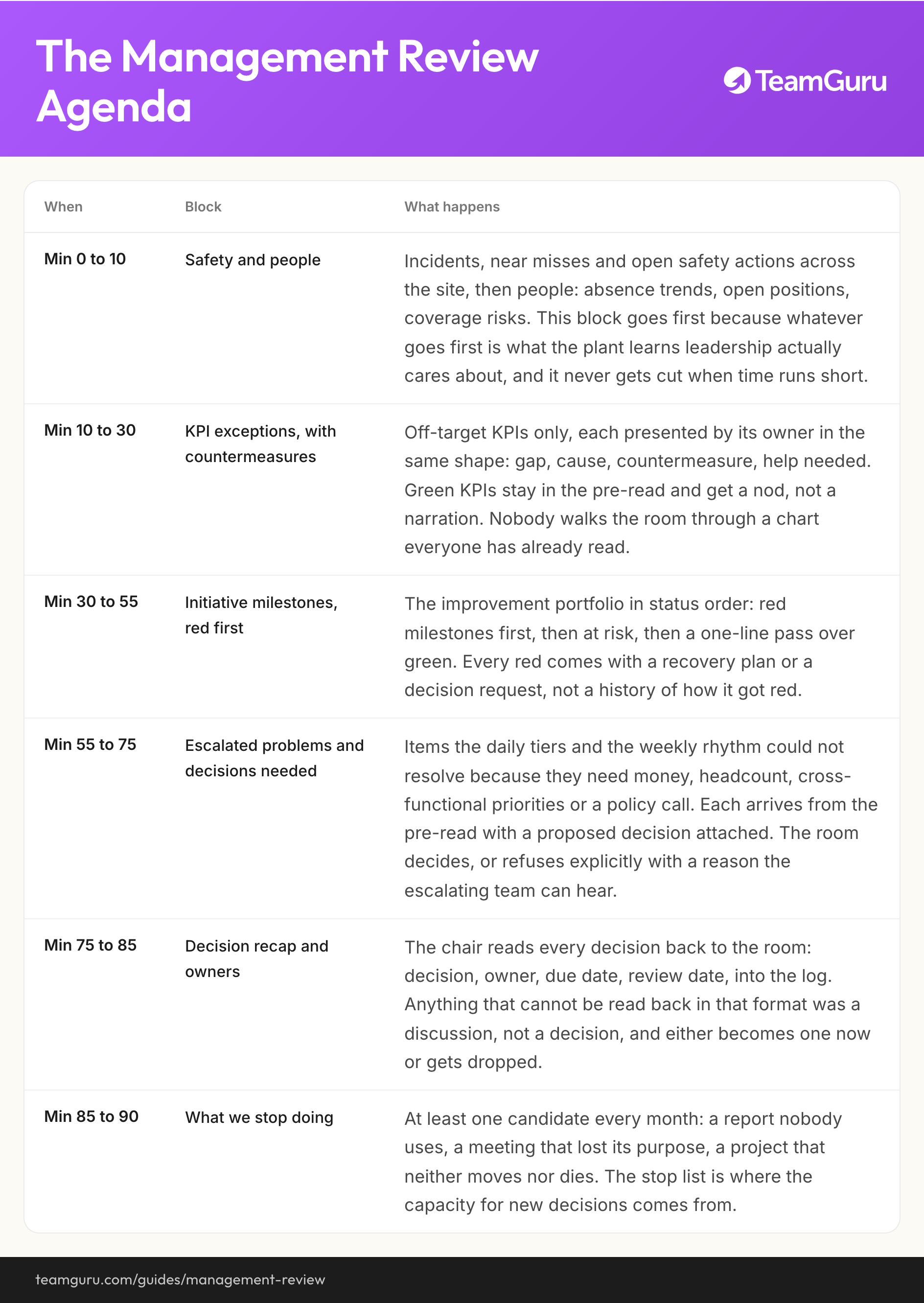
The 90-minute agenda
The same agenda every month, in the same order, so the meeting runs on rhythm instead of on the chair's energy. The proportions carry the philosophy: two thirds of the time goes to exceptions, milestones and escalations, and the meeting ends by reading its own output back.
| When | Block | What happens |
|---|---|---|
| Min 0 to 10 | Safety and people | Incidents, near misses and open safety actions across the site, then people: absence trends, open positions, coverage risks. This block goes first because whatever goes first is what the plant learns leadership actually cares about, and it never gets cut when time runs short. |
| Min 10 to 30 | KPI exceptions, with countermeasures | Off-target KPIs only, each presented by its owner in the same shape: gap, cause, countermeasure, help needed. Green KPIs stay in the pre-read and get a nod, not a narration. Nobody walks the room through a chart everyone has already read. |
| Min 30 to 55 | Initiative milestones, red first | The improvement portfolio in status order: red milestones first, then at risk, then a one-line pass over green. Every red comes with a recovery plan or a decision request, not a history of how it got red. |
| Min 55 to 75 | Escalated problems and decisions needed | Items the daily tiers and the weekly rhythm could not resolve because they need money, headcount, cross-functional priorities or a policy call. Each arrives from the pre-read with a proposed decision attached. The room decides, or refuses explicitly with a reason the escalating team can hear. |
| Min 75 to 85 | Decision recap and owners | The chair reads every decision back to the room: decision, owner, due date, review date, into the log. Anything that cannot be read back in that format was a discussion, not a decision, and either becomes one now or gets dropped. |
| Min 85 to 90 | What we stop doing | At least one candidate every month: a report nobody uses, a meeting that lost its purpose, a project that neither moves nor dies. The stop list is where the capacity for new decisions comes from. |
Notice what the agenda does not contain: a round-the-table opening, a finance deep dive, or department presentations. Finance numbers live in the pre-read like everything else. Any topic that needs 30 minutes of shared analysis gets its own working session with only the people who can contribute, scheduled in the room, held elsewhere.
The decision log
Six columns, one row per decision, and it doubles as the minutes. The review date column is the one most logs miss and the one that makes the log work: every decision states when the room will check that it happened and that it worked, which is a different date from when it is due. The rows below are illustrative, from the same 450-person components manufacturer used across the transformation roadmap, a plant shipping 456 units per day and working its on-time delivery up from 79 percent.
| Date | Decision | Owner | Due | Review date | Status |
|---|---|---|---|---|---|
| Mar 12 | Fund the machining changeover reduction project: toolroom reserved two days per month, target 47 to 18 minutes, batch sizes reviewed after every step change | Value stream manager | Aug 31 | Every review until closed | On track |
| Apr 9 | Stop the packaging relayout project. Its remaining engineering hours move to the assembly bottleneck until OTD holds above 85 percent for a full quarter | Engineering manager | Apr 30 | May review | Closed, verified |
| May 14 | Add a second maintenance technician on night shift: night breakdown response averages 41 minutes against 12 on days, and machining loses 33 minutes a day to breakdowns | Plant manager | Jul 1 | Aug review, against the downtime trend | In progress |
Three details keep a log alive. First, the log is public inside the leadership team, so a logged decision cannot be quietly renegotiated. Second, due decisions are flagged in the next pre-read automatically, so follow-up costs nobody any memory. Third, the second example row is in the log at all: a stop decision is logged with the same discipline as a funding decision, because unmade stop decisions are where plants leak the most capacity.
Chairing behaviors that make it work
The agenda and the log are paper. What decides whether the review changes anything is how the chair behaves for 90 minutes, because the room reads the chair, not the template. Five behaviors carry most of the weight:
- Ask for countermeasures, not explanations. Replace why is it red with what is your countermeasure and what do you need. The first question produces history, the second produces work.
- Thank people for red numbers reported early, out loud, in the room. The gratitude is not politeness, it is system maintenance: it keeps next month's dashboard honest.
- Kill zombie projects. Any initiative with no milestone movement for two consecutive reviews gets a stop-or-recommit decision, not a third month of polite status.
- Decide in the room. If everyone needed for a decision is present, taking it offline is a refusal wearing a suit. Offline is only legitimate when information, not courage, is missing.
- Protect the last five minutes. The stop-doing slot is the first thing squeezed when the meeting overruns, and it is the slot that funds everything else.
The second behavior deserves a defense, because it feels backwards. Punishing red numbers buys you green lies. The first time a leader is grilled for an honest red, every other leader in the room recalculates what to report next month, and the dashboard begins its slow drift toward decorative. The discipline is to separate the number from the person: a red number with a credible countermeasure is a leader doing the job, and a red number surfaced early is worth more to the site than a green one, because it can still be acted on. Pressure belongs on missing countermeasures and slipping decisions, never on the color itself.
The cadence architecture around it
The monthly review is one layer of a stack, and each layer exists to handle what the faster layer below it cannot. When the layers are healthy, nothing waits a month that could be decided in a day, and the review receives patterns instead of surprises.
| Rhythm | Cadence | The question it answers |
|---|---|---|
| Tier meetings | Daily | Did yesterday run to standard, and who acts today? Deviations answered in hours. |
| Obeya review | Weekly | Are KPIs, projects and problems moving, and what needs unblocking this week? |
| Management review | Monthly | What patterns need decisions: resources, priorities, the portfolio, escalations needing authority. |
| Strategy adjustment | Quarterly | Are the annual objectives still the right ones, and what shifts in targets or resourcing? |
| Hoshin planning | Annual | What are next year's few breakthrough objectives, and who commits to what? |
The stack shares one nervous system. The daily layer is the tier meeting cascade, the weekly layer typically runs as an Obeya review, and the annual layer is Hoshin planning, whose objectives the quarterly adjustment keeps honest. Critically, every layer reads the same numbers at a different altitude: the shift-level metrics on the boards roll up through the KPI tree into the results the review steers. The moment the review runs on a different dataset than the floor, the layers stop being one system and start being an org chart of meetings.
What happens next
A review that reliably produces decisions changes what the rest of the system asks of it. Escalations arrive with proposed decisions because teams learn they will get an answer. The initiative portfolio gets leaner because zombie projects stop surviving by silence. And the review itself usually migrates into an Obeya, where the walls replace most of the pre-read and the monthly meeting becomes a deeper pass over the same surfaces the weekly rhythm already walks.
The recurring cost of a good review is input preparation and follow-up bookkeeping, and this is where TeamGuru fits the practice: the reporting and KPI management use cases end the report-preparation industry, because the review reads the same live dashboards the tiers use, frozen for the month, with exceptions already flagged. The meeting management use case keeps the agenda, the minutes and the decision log in one place, with every decision linked to the actions that implement it, so the review date on each log row arrives with its evidence attached.
On the roadmap, the practice that follows is standardize and scale: once one site's review rhythm reliably turns exceptions into decisions, the same architecture, agenda, log and chairing contract becomes the template other sites adapt, and the multi-site review reads one shared tree of numbers instead of a binder of formats.
Take this with you
The diagram from this guide as a shareable image, free to reuse in internal training and workshops.
Download PNGFrequently asked questions
How long should a monthly management review be?
Who should attend a management review?
What does exception-based reporting mean?
How is a management review different from tier meetings?
What belongs in the pre-read?
How do we stop the review from growing longer every month?
How TeamGuru runs this