Implementation Guide
Catchball.
Catchball is the negotiation step inside Hoshin planning where proposed targets pass back and forth between organizational levels until they become commitments. The receiving level throws back with data: here is what we can commit to, here is the gap, and here is what we need. A target that never came back changed was never really caught. Done honestly, two to four weeks of catchball replace a year of quiet non-ownership.
What catchball is
Catchball is the deployment verb inside Hoshin planning: the step where a proposed target stops being a message and becomes a negotiation. One level throws a target down with its reasoning. The level below studies it against its own data and throws it back: here is what we can commit to with current means, here is the gap to your number, and here is what we would need to close it. The rounds continue until both levels hold the same number, with its conditions, in writing.
The name is meant literally. A ball that is thrown and never returned was not caught, it was dropped. That is the difference between catchball and cascading: a cascade communicates, catchball negotiates. Both produce a spreadsheet of targets by January. Only one of them produces people who meant it.
The working test is whether targets come back changed. If every number survives deployment exactly as proposed, one of two things is true: the top level has perfect knowledge of changeover times, staffing gaps and machine health three levels down, or the levels below decided that arguing is unsafe and signed up for numbers they privately do not believe. The first is rare. The second is how plants end up explaining misses in October that their supervisors predicted in February.
Where catchball sits in the roadmap
Catchball belongs to the strategy deployment practice in the Build the Frame stage of the transformation roadmap. It depends on the Diagnose stage more than it looks: the counters that make catchball real are built from the numbers a current-state assessment produced. It runs alongside future-state design, which supplies the improvement projects that become conditions on targets, and it hands its output, owned targets with written conditions, to daily management, where the numbers meet the shop floor.
- Before Current-State Assessment
- You are here Strategy Deployment
- In parallel Future State Design
- After Daily Management
Why cascade-by-email fails
The standard alternative is the cascade: leadership computes the annual targets, allocates them down a spreadsheet, and communicates the result in a town hall and an email. It is fast, it is tidy, and it fails the same way every year. The numbers arrive without ownership. Nobody at the receiving end was asked what the number would take, so nobody surfaced the conditions, so the resources the target depended on were never argued for while budget was still on the table.
The illusion of alignment this creates is more dangerous than open disagreement. A plant where a value stream manager says, during planning, that 92 percent is not achievable with current changeover times is a plant that can decide something: fund the changeover project or accept 88. A plant where everyone nods discovers the same fact in the Q3 review, as an explanation, when the options have already closed. Disagreement in January is information. Agreement that nobody meant is a time bomb with a fiscal-year fuse.
The symptoms of a cascade are easy to check: managers who cannot say where their number came from, targets whose enabling conditions live in nobody's plan, capacity conflicts discovered during execution, and a fourth-quarter ritual of explaining variances that the people closest to the process predicted before the year began.
How to run catchball
Run catchball between adjacent level pairs: site leadership with value stream or area managers first, then area managers with their teams for the targets that moved. Do not run a serial relay through six organizational levels; run the pairs in parallel and timebox the whole exercise to two to four weeks. Catchball is a phase of the planning calendar with an end date, not a standing committee.
A round is a throw with content requirements. The opening throw carries the proposed number and the strategic reasoning behind it. The return throw carries three things: the number this level can commit to with current means, the gap to the proposal, and the needs that would close the gap. The closing round is a decision: fund the needs, accept the counter, or make the call and own the risk it named.
The senior side has the harder job. The counter is not resistance; it is the entire point of the method, and the way a manager receives the first one decides whether there will ever be a second. Treat a data-carrying counter as disloyalty and you get exactly one season of honesty, followed by years of polite nodding. Experienced practitioners thank the first honest counter loudly and in public, because everyone else is watching to see what happens to the person who threw it.
Know when to stop. Two honest rounds beat five polite ones; that is an opinion, and this page holds it firmly. By round three the conversation should end in one of three sentences: we fund it, we accept your number, or we are choosing the risk and it is now mine. Anything still open after that is not negotiation, it is drift.
A three-round dialogue, worked
The numbers below are illustrative but internally consistent, from the same 450-person components manufacturer used across these guides: 456 units per day, two shifts, on-time delivery at 79 percent, and a 47-minute machining changeover that a SMED project could take to 18.
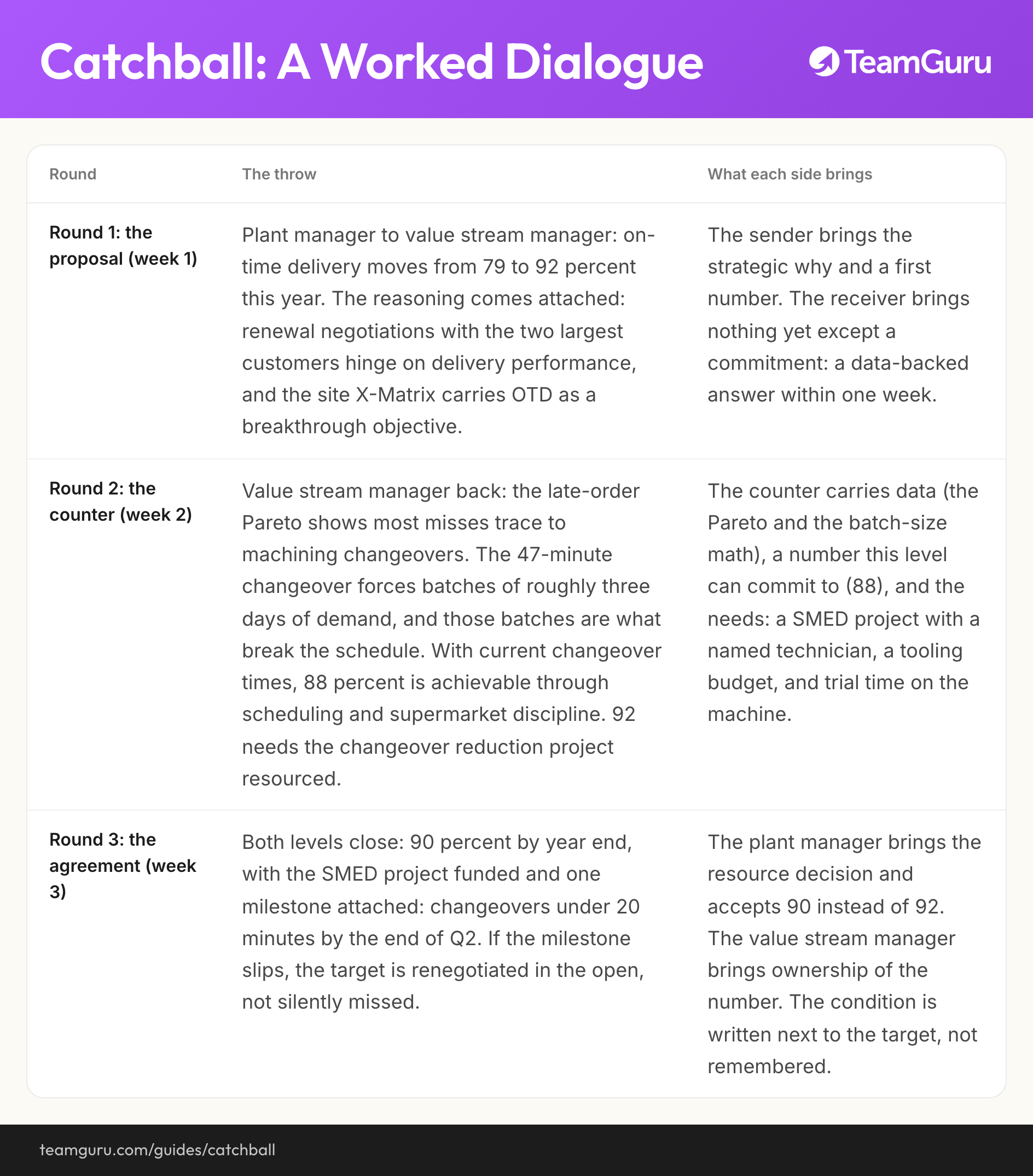
| Round | The throw | What each side brings |
|---|---|---|
| Round 1: the proposal (week 1) | Plant manager to value stream manager: on-time delivery moves from 79 to 92 percent this year. The reasoning comes attached: renewal negotiations with the two largest customers hinge on delivery performance, and the site X-Matrix carries OTD as a breakthrough objective. | The sender brings the strategic why and a first number. The receiver brings nothing yet except a commitment: a data-backed answer within one week. |
| Round 2: the counter (week 2) | Value stream manager back: the late-order Pareto shows most misses trace to machining changeovers. The 47-minute changeover forces batches of roughly three days of demand, and those batches are what break the schedule. With current changeover times, 88 percent is achievable through scheduling and supermarket discipline. 92 needs the changeover reduction project resourced. | The counter carries data (the Pareto and the batch-size math), a number this level can commit to (88), and the needs: a SMED project with a named technician, a tooling budget, and trial time on the machine. |
| Round 3: the agreement (week 3) | Both levels close: 90 percent by year end, with the SMED project funded and one milestone attached: changeovers under 20 minutes by the end of Q2. If the milestone slips, the target is renegotiated in the open, not silently missed. | The plant manager brings the resource decision and accepts 90 instead of 92. The value stream manager brings ownership of the number. The condition is written next to the target, not remembered. |
Notice what round two did: it moved the conversation from ambition to physics. The counter never said the target was too high; it said what the target costs. That is why the final 90 with a funded project is stronger than the original 92. It arrives with a plan, a milestone and an owner instead of hope, and the plant manager knows exactly what was traded for the two points.
The ground rules
Catchball survives on a small set of rules that everyone knows and the senior level visibly follows. Publish them with the planning calendar, and let anyone at any level call a violation without ceremony.
- Every throw comes back within a week. A target sitting in an inbox is not being considered, it is being avoided, and the planning window is burning.
- Counters must carry data. “Too ambitious” is an opinion; a Pareto of last year's misses with the constraint named is an answer.
- Needs are part of the answer. “We can hit 92 if the changeover project is resourced” is a complete throw. “We cannot hit 92” is half of one.
- Silence is not agreement. A level that never threw back has not committed, whatever the deployment spreadsheet says.
- The final number is written with its conditions. If the target depends on a project, the project milestone lives next to the target, and a slipped milestone reopens the number.
Catchball beyond annual targets
The same throw-and-return mechanics deploy more than KPI numbers. Initiative selection travels well: teams propose improvement projects upward, leadership throws back with strategic fit and capacity limits, and the portfolio that survives two rounds is smaller, better argued and actually owned. Resource conflicts travel too: when two value streams both need the one toolmaker, a catchball round in planning decides the trade while it is still a scheduling question, instead of leaving it to be fought over in execution when it has become an emergency.
Midyear renegotiation is the third use. When a written condition slips, say the SMED milestone moves out a quarter, rerun one small catchball round on the affected target instead of letting it die quietly. A renegotiated 89 with a revised date preserves something a silently missed 90 destroys: the habit of numbers meaning what they say.
Common failure modes
Most catchball failures follow a few visible patterns, and the subtlest one is the forgotten condition: a target agreed with a condition attached, the condition slips, and by review time only the number is remembered and enforced. Prevent that structurally, not heroically. Write conditions into the X-Matrix next to the targets they enable, so every review that reads the target reads its conditions in the same glance.
What bad looks like
- The answer was fixed before the first throw; the rounds are scheduled theater
- Endless loops: round five and counting, negotiation as a delay tactic
- Data-free pushback: counters that carry adjectives instead of Paretos
- Conditions agreed verbally in March, forgotten by June, target enforced in October
- A serial relay through every level that consumes the whole quarter
What good looks like
- Every manager can explain their number and the reasoning above it
- Return throws arrive within a week and carry data, a number and needs
- Two to three rounds per level pair, then a decision someone owns
- Conditions written next to targets in the X-Matrix and reviewed with them
- The first honest counter of the season is publicly thanked
After catchball: from commitment to review
Catchball is finished when every breakthrough target has three things: an owner one level down who said the number out loud, conditions in writing, and a review rhythm. From there each target becomes the root of a KPI tree branch, so shift-level numbers connect to it causally, and its progress lands in the monthly management review, where a slipping condition triggers renegotiation instead of blame.
This handoff is also where deployment usually leaks. The round-three agreement lives in meeting minutes, and by summer nobody can find what was conditional on what. In TeamGuru's strategy deployment use case, objectives are recorded with their owners and the conditions attached, so the review reads the actual agreement rather than the memory of it.
Free tool
Write the round-three agreement down as an X-Matrix
Objectives, owners, initiatives and metrics on one page, with the correlations marked. Export PNG or PDF, share a link. No account.
On the roadmap, the next move is daily management: the agreed targets reach tier boards as the numbers a shift can influence, which is where a commitment made in a planning room starts being kept on a Tuesday.
Take this with you
The diagram from this guide as a shareable image, free to reuse in internal training and workshops.
Download PNGFrequently asked questions
Where does the name catchball come from?
How many rounds of catchball are normal?
How long should catchball take?
What happens if two levels cannot agree?
Is catchball only for annual planning?
How is catchball different from normal target setting?
How TeamGuru runs this