Implementation Guide
SMED.
SMED (single-minute exchange of die) is a Lean method for cutting changeover time: film the changeover as it is, separate work that can happen while the machine runs from work that cannot, convert as much as possible to the first kind, then streamline what remains. SMED buys flexibility, not capacity. If batch sizes do not shrink after the project, the project bought nothing.
What SMED is, and what it buys
SMED stands for single-minute exchange of die: the discipline of driving changeover time, measured from the last good piece of one product to the first good piece of the next, down toward single digits of minutes. The name comes from stamping dies, but the method works on any setup: machining fixtures, molds, filling lines, format changes. Its core insight is a separation. Some changeover work is internal, possible only while the machine is stopped. Most of the rest is external, possible while the machine is still producing, and in an unimproved changeover the external work is done internally: the machine stands still while someone looks for a wrench.
Here is the stance this page defends: SMED buys flexibility, not capacity. A faster changeover does return some machine time, but that is the small prize, and on a non-constraint machine it is no prize at all. The real product of an 18-minute changeover is that changeovers stop being expensive, so batches can shrink, so the schedule can follow the customer instead of following the changeover. Long changeovers force large batches, large batches create inventory and long lead times, and no amount of scheduling cleverness escapes that arithmetic. SMED attacks the cause.
Which yields the test every SMED project should be held to: what happened to batch sizes? If six months after the celebration the planner is still releasing three-day batches, the project bought a poster and nothing else. The changeover number is the means. The batch size is the result.
Where SMED sits in the transformation roadmap
On the TeamGuru deployment roadmap, SMED belongs to the equipment and methods practice in the Improve stage. That placement is deliberate. Changeover reduction pays off where daily management already exists to hold the gains, and its targets should come from the value stream analysis, which names the machine whose changeover forces the batches. Changeovers are also one of the six big losses in OEE, so a plant measuring OEE honestly already knows how many minutes per day are on the table, and on which machine.
- Before Daily Management
- You are here SMED, TPM, FMEA & Poka-Yoke
- In parallel Kaizen
- After Obeya & Management Reviews
When SMED is premature or misdirected
SMED is one of the most reliably successful Lean methods when aimed well, and one of the most wasteful when aimed badly. Hold off, or re-aim, when any of these is true:
- The machine is not a constraint and does not force batch sizes anywhere. Cutting its changeover produces a nicer number and no business result; the machine simply waits faster. Aim at the machine the value stream map points to.
- Basic stability does not exist yet. If the area has no daily management rhythm and no standard work habit, the new changeover method has nothing to live in, and the time will drift back within a quarter.
- The real goal is capacity on a machine drowning in breakdowns. When availability losses dwarf changeover losses, maintenance comes first; an 18-minute changeover on a machine that is down two hours a day solves the wrong problem.
- Nobody intends to change batch sizes. If planning, purchasing and finance are committed to long runs regardless, agree on that decision first. A flexibility project for a plant that refuses flexibility is theater.
How to run a SMED project
The classic method, developed by Shigeo Shingo, runs in four stages, and the sequence is the method: teams that skip to stage four buy hardware to speed up steps that stages two and three would have removed entirely. The stages compress well into a focused week, and a SMED project is in fact one of the best first kaizen events a plant can run, because the before and after are measured in minutes on a stopwatch and nobody can argue with the video.
| Stage | What happens | Typical gain |
|---|---|---|
| 1. Document the changeover as it is | Film one real changeover from the last good piece of product A to the first good piece of product B, then build a step list with times from the footage, together with the crew that did it. | No minutes removed yet. The gain is an honest baseline and the discovery that much of the changeover is searching, walking and waiting, not technical work. |
| 2. Separate internal from external work | Classify every step: internal work needs the machine stopped, external work does not. Move every external step outside the stop: tools found, fixture staged, materials and paperwork ready before the last good piece. | Often 30 to 50 percent of the stop, with almost no investment. This is organization, not engineering. |
| 3. Convert internal work to external | Redesign steps so they can happen while the machine still runs: preset tooling offline, preheat, use duplicate holders or fixtures, prepare settings and programs in advance on a changeover cart. | Typically another 10 to 25 percent. This is where modest hardware starts to pay: carts, presetting stations, a second fixture. |
| 4. Streamline what remains | Attack the residual internal work: quick-release clamps instead of bolts, locating pins instead of measurement and adjustment, two people working in parallel, a standardized first-piece check instead of trial and error. | The path to single digits. Eliminating adjustment is usually the biggest single win, because adjustment is the least predictable step of any changeover. |
The percentage figures are practitioner heuristics, not guarantees. Their order is the point: the cheap organizational gains come first, the hardware comes last.
The project, step by step
- Pick the changeover that matters. One machine, one product pair, chosen because the value stream analysis says its changeover is what forces big batches, not because it is the easiest to film. Pull the baseline from real records: every changeover time for the last month, not the planner's standard.
- Film one real changeover, with the crew's agreement. Camera on a tripod, from last good piece to first good piece, nothing staged. The next day the crew watches its own footage and builds the step list with times. This is the moment the project is won or lost: people who see themselves walk 400 meters for a wrench do not need convincing.
- Separate internal from external, and move the external out. Go through the step list and ask one question per step: does the machine really have to be stopped for this? Everything that fails the test gets a place and a time before the stop: a stocked cart, a staged fixture, prepared paperwork. No hardware spending yet.
- Convert what internal work you can. Preset tooling offline, duplicate the fixture or holder so the next one is assembled while the machine runs, standardize settings so they are dialed in from a sheet instead of rediscovered. Each conversion is judged by the internal minutes it removes.
- Streamline the rest. Quick-release clamps, locating pins, parallel work with two people for the mechanical swap, and above all the elimination of adjustment: if the fixture can only go on in one position, the trial-and-error tail of the changeover disappears.
- Standardize the new method and track every changeover. The new sequence becomes standard work: steps, roles, cart layout, first-piece check, posted at the machine and trained to every crew on every shift. From day one, every changeover time is recorded and misses are discussed in the daily meeting like any other deviation.
The last step is where most projects quietly fail. A changeover method that lives in a workshop report is not a method, it is a memory. The new sequence has to become standardized work at the machine: who does what, in what order, with which cart, and what the first-piece check accepts. Every crew, every shift, including the night shift that was not in the workshop. That is not bureaucracy; it is the container the 18 minutes is stored in.
Worked example: 47 minutes to 18
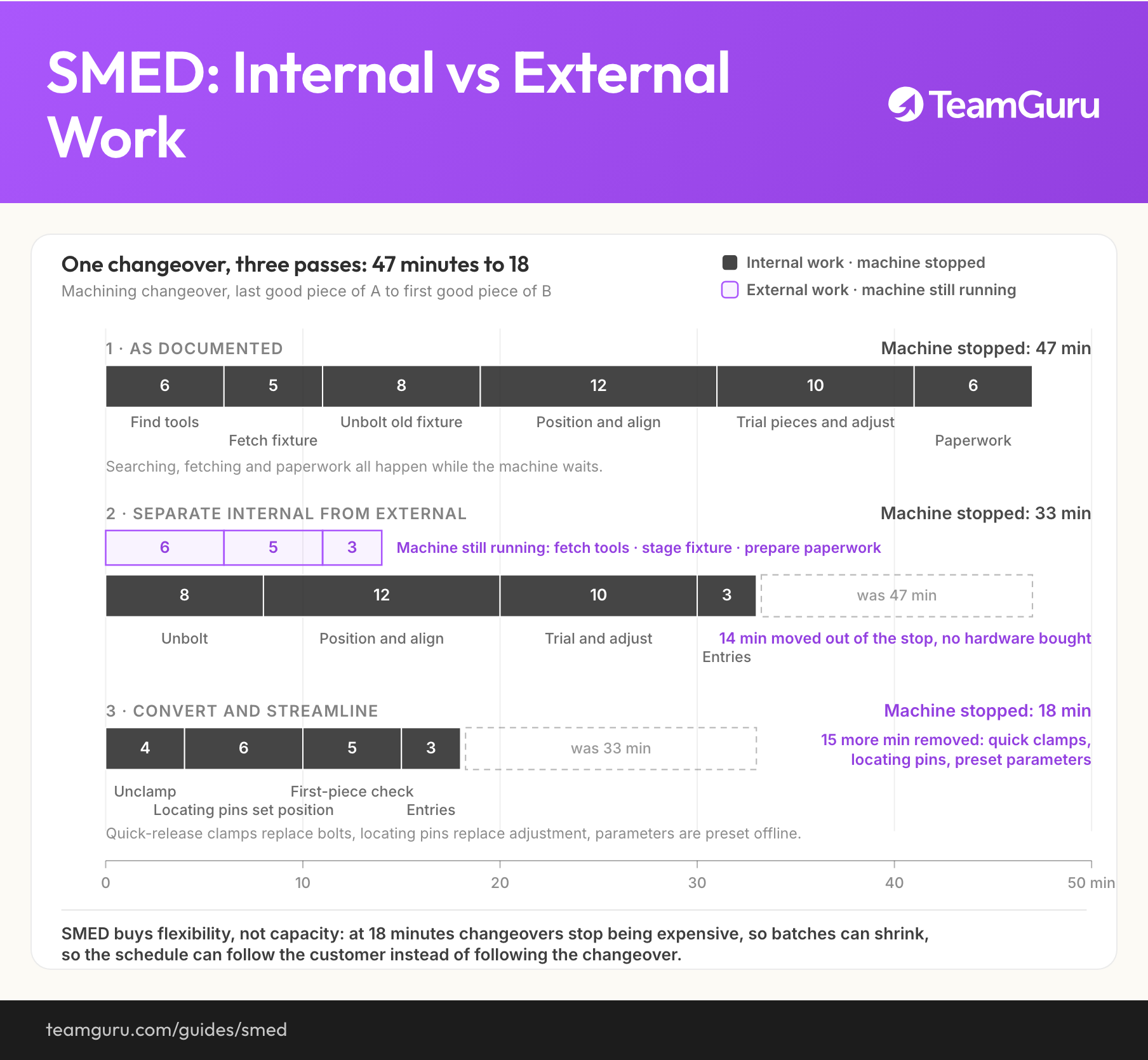
The numbers are illustrative but internally consistent, for the 450-person components manufacturer used across the transformation roadmap: 456 units per day of demand, two shifts, 54,000 seconds of daily working time. Its value stream map marked a kaizen burst on the machining changeover: 47 minutes, forcing batches of roughly three days of demand and a six-day inventory pool in front of the machine. The SMED team filmed one changeover and broke it down like this:
| Changeover step | Before (min) | After (min) | Technique |
|---|---|---|---|
| Find tools and hardware | 6 | 0 | External: a shadow-board changeover cart, stocked and checked during the previous run |
| Fetch the next fixture | 5 | 0 | External: fixture staged at the machine before the last good piece |
| Unbolt and remove the old fixture | 8 | 4 | Streamline: quick-release clamps replace bolts |
| Position and align the new fixture | 12 | 6 | Streamline: locating pins replace measure-and-adjust alignment |
| Trial pieces and adjustment | 10 | 5 | Streamline: preset parameters and a standardized first-piece check replace trial and error |
| Paperwork and system entries | 6 | 3 | Converted: entries made during ramp-up, not while the machine waits |
| Machine stopped, total | 47 | 18 | Internal time only; external prep now runs during production |
Read the table by technique and the method's logic shows through. Eleven of the 47 minutes, finding tools and fetching the fixture, were pure external work done internally; a stocked cart and a staging rule removed them without touching the machine. Twenty of the remaining minutes, unbolting and aligning, were cut in half by hardware that removes options: clamps that close one way, pins that locate one position. And the trial-and- adjust tail shrank because adjustment itself was designed out; when the fixture can only sit in one place, the first piece is usually good. Nothing in the table asks anyone to work faster. The stopwatch never argues with the crew, only with the method.
Converting minutes into flexibility
The batch size math is short and worth doing out loud. A changeover budget, the minutes per day a machine can afford to spend not producing, buys a number of changeovers. At 47 minutes each, the machining area could afford so few that each product variant ran about once every three days, so every variant sat in a three-day batch and the supermarket in front of machining held six days of material to cover the interval. At 18 minutes, the same daily budget buys nearly three times as many changeovers: every variant can run close to every day, batches shrink by about two thirds, and the supermarket shrinks with them. That is exactly the move the plant's future-state value stream map priced in when it cut planned WIP from 8,400 to 3,300 pieces. The schedule now follows demand, and the changeover no longer votes.
This is why the project's closing meeting must include the planner. The new batch size, the new supermarket levels and the new every-part-every-interval are decisions, and unless someone changes them in the planning system, the 29 minutes saved per changeover simply become idle time and the inventory stays. SMED ends in the scheduler's parameters, not at the machine.
Common mistakes
What bad looks like
- Hardware first: quick clamps and a second fixture bought before anyone filmed a changeover or separated internal from external work
- Operators blamed for long changeovers that are 40 percent walking and searching by design
- Changeover times recorded for the record, averaged monthly, reviewed never
- The workshop result never becomes standard work, and the night shift keeps the old method alive
- The number improves, batch sizes stay, and inventory never moves
What good looks like
- The target machine chosen by the value stream analysis, not by convenience
- The crew films itself, builds the step list, and designs the new method
- Separation and staging exhausted before a single euro of hardware
- The new sequence posted at the machine as standard work, trained to every shift
- Every changeover timed, misses discussed daily, the standard audited quarterly
- Batch sizes and supermarket levels changed in the planning system within a month
After the project: keeping the 18 minutes
Two things follow a successful SMED project, and both need owners. The first is the value stream consequence: smaller batches change the design of the whole flow, supermarket sizes, replenishment signals, and how often each part runs. Those decisions belong in the future-state value stream design, which is where the changeover project came from in the first place, and closing the loop there is what turns minutes into lead time.
The second is defense. Changeover times drift back the way all unattended standards drift, one small shortcut per month, and the drift is invisible without measurement. This is where TeamGuru earns its place in the chain: the changeover sequence and first-piece check live as a scheduled checklist and audit at the machine, times are tracked as a KPI with a red rule instead of a monthly average, and the improvement ideas the crews keep generating after the workshop, better cart layouts, a second pin, a smarter first-piece routine, flow through the kaizen pipeline with owners and verification instead of dying in a suggestion box. The workshop won the 18 minutes once. The system keeps winning them every day after.
Take this with you
The diagram from this guide as a shareable image, free to reuse in internal training and workshops.
Download PNGFrequently asked questions
What does SMED stand for?
Does every changeover need to be under ten minutes?
What is the difference between internal and external changeover work?
How much does a SMED project cost?
Should we film operators during changeovers?
How do we keep changeover times from creeping back up?
How TeamGuru runs this