Implementation Guide
Obeya.
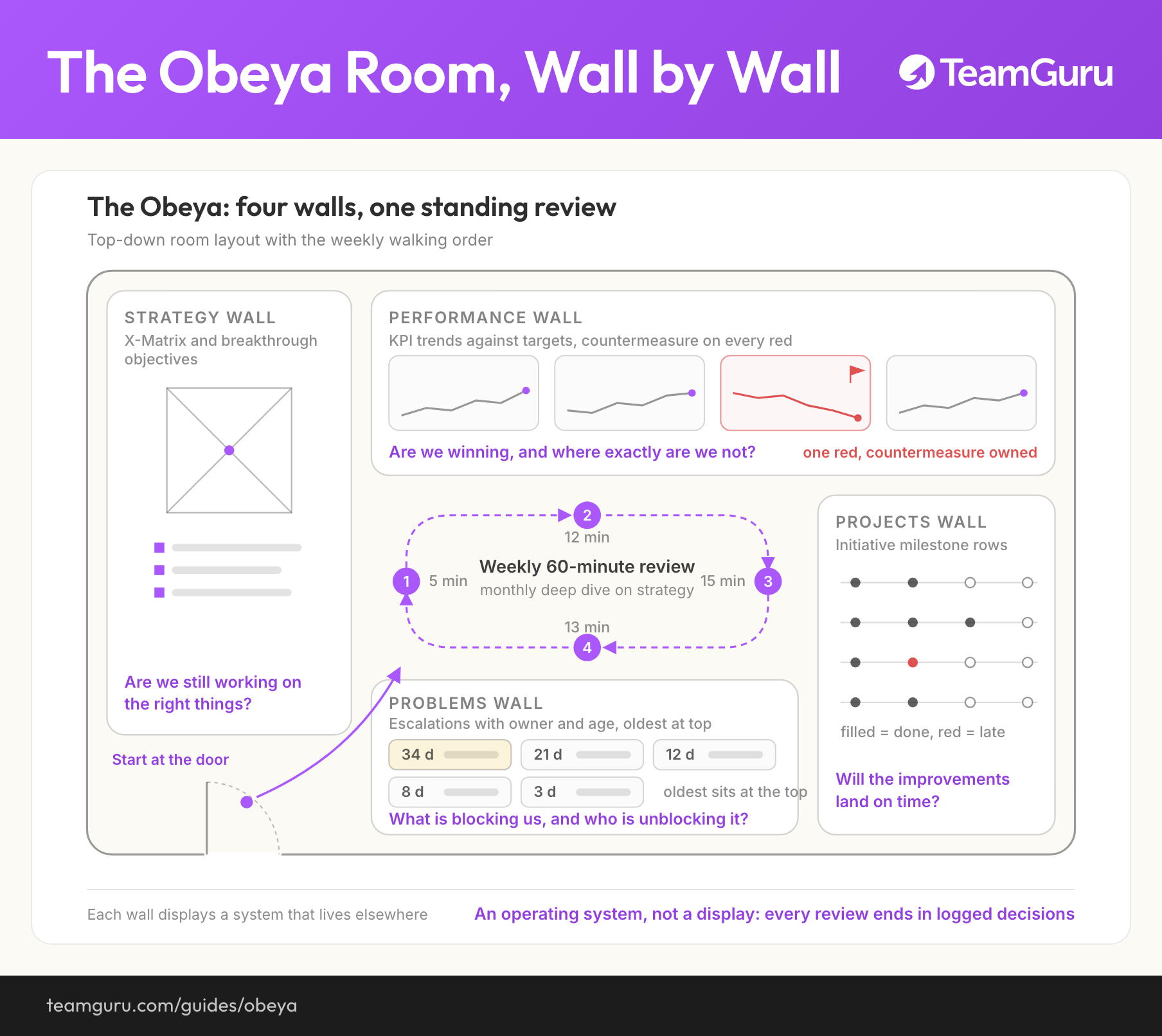
An Obeya is the room, physical or digital, where a leadership team runs its management system on four walls: strategy, performance, projects, and problems. The idea comes from Toyota product development, adapted in manufacturing as the standing place where everything built earlier, KPIs, initiatives, problem solving, meets weekly. An Obeya without decisions, ownership and follow-up is just an expensive wall. The room earns its cost only when every review ends in decisions logged with owners.
What an Obeya is
Obeya is Japanese for big room. The idea comes from Toyota product development, where a chief engineer would put the whole cross-functional team, every open issue and every key decision into one room, so a complex program could be seen and steered from one place. Manufacturing operations borrowed the room for a different job: not running one program, but running the management system itself. The walls hold the four things a leadership team must keep in view at once, strategy, performance, projects and problems, and the team meets in front of them on a fixed weekly rhythm.
The Obeya creates no new information. That is its point. The X-Matrix, the KPI trends, the milestone plans and the problem-solving pipeline all exist before the room does; the room puts them in one field of view so the connections become visible. The red KPI hangs next to the project that is supposed to fix it, which hangs next to the escalation that is blocking the project. Read separately in four different meetings, those are three status updates. Read together on three walls, they are one decision waiting to be made.
Which leads to the test this whole page defends: an Obeya without decisions, ownership and follow-up is just an expensive wall. The walls are memory. The weekly meeting is the mechanism. The decision log, with an owner and a date on every entry, is the proof that the mechanism ran. A visitor should be able to judge the room in two minutes by reading the log, not the walls.
The four walls, and the question each one answers
Layouts vary, but the content structure below covers what a plant leadership team needs. Each wall exists to answer one question; anything on a wall that does not help answer its question is taking up attention that something else deserves.
| Wall | What belongs on it | The question it answers |
|---|---|---|
| Strategy wall | The X-Matrix, the 3 to 5 breakthrough objectives, the annual improvement priorities, and the breakthrough KPIs with their year-end targets. Nothing operational, nothing weekly. | Are we still working on the right things? |
| Performance wall | KPI trends against targets, weekly and monthly, with exceptions marked and a countermeasure named next to every red. Trends, not snapshots: a single month tells you nothing about direction. | Are we winning, and where exactly are we not? |
| Projects wall | One row per strategic initiative: owner, milestones with dates, red or green against plan. Only the projects that carry the annual priorities, not every project in the plant. | Will the improvements land on time? |
| Problems wall | Open structured problem-solving cases and escalations from the tier cascade that need leadership attention, each with an owner and its age visible. The oldest items sit at the top, on purpose. | What is blocking us, and who is unblocking it? |
The strategy wall is fed by hoshin kanri and carries the X-Matrix; the problems wall is fed by the tier cascade and the problem-solving pipeline. That is the pattern for every wall: the room displays systems that live elsewhere. When a wall has no system behind it, the wall is announcing a gap, which is useful information too.
Where the Obeya sits in the transformation roadmap
On the TeamGuru deployment roadmap the Obeya belongs to the Obeya and management reviews practice, late in the sequence on purpose: it integrates what the earlier stages built. It assumes daily management already runs at the boards and structured problem solving already produces owned cases, because those are what two of its four walls display.
- Before Daily Management
- Before Structured Problem Solving
- You are here Obeya & Management Reviews
- In parallel Skills Matrix
- After Standardize & Scale
When not to build one
The Obeya is an integration layer. If the systems it integrates do not exist, the room cannot summon them, and building it early produces the most expensive failure mode in visual management: a beautiful room about nothing. Do not build one when:
- There is no daily management system yet. An Obeya built on top of firefighting is a war room, and war rooms die with the war. Build the tier cascade and the boards first; the Obeya is where their output goes, not a substitute for them.
- Strategy has not been deployed. Without agreed priorities and an X-Matrix, the strategy wall becomes motivational posters, and the projects wall becomes a list of everything anyone is doing.
- There is no problem-solving discipline. The problems wall needs a pipeline of real cases with owners and methods behind them. Without that, it is a complaint board, and complaint boards teach people not to raise problems.
- Leadership will not commit to the rhythm. A room whose weekly meeting keeps getting canceled is a museum with good lighting. If the calendar cannot protect one hour a week, fix the calendar before building the room.
The first condition is the one most often skipped. A daily system, boards plus tier meetings plus leader routines, is described in the lean daily management guide; the Obeya consumes its escalation stream. Without that stream, the problems wall fills with whatever leadership happens to worry about this week, which is firefighting with better graphics.
How to set one up
Setting up an Obeya is mostly a curation exercise: deciding which existing artifacts earn wall space, who keeps each wall current, and what rhythm the room runs on. The physical build, walls, printouts or screens, is the easy week at the end.
Choose the wall content from what already exists
The X-Matrix, the KPI trends, the milestone plans, the problem-solving pipeline: all of it should already live somewhere because earlier practices built it. The rule that keeps the room honest: never create content only for the room. If a wall needs a document that nobody uses outside the Obeya, the wall is wrong, not the document.
Name a wall owner for each wall
Not a coordinator who chases inputs, but the person who owns the underlying system: the strategy owner keeps the strategy wall, the CI leader keeps the problems wall. The owner's standard is simple: current before every review, with the update date visible on everything.
Design the cadence before the layout
A weekly 60-minute leadership review plus a monthly deep dive, which is where the management review lives. Daily tier meetings stay at their boards; the Obeya does not replace them, it receives what they escalate. Fix the day and hour and defend them.
Decide physical, digital or hybrid honestly
The comparison below is the real trade-off. The short version: a single site with co-located leadership can run a physical or hybrid room well; a leadership team spread across sites or time zones needs a digital Obeya, because a room the leaders cannot stand in is a room in name only.
Pilot for a month, then prune
First versions overload every wall. Run four weekly reviews, then remove everything that no decision touched. A wall earns its space by changing what the team does; the rest is decoration.
Physical versus digital, honestly
Both work. Both fail in characteristic ways. The choice should follow geography and data flow, not preference for sticky notes or for screens.
| Dimension | Physical room | Digital Obeya |
|---|---|---|
| Ritual and presence | Standing together in front of the walls builds the habit fast; the room itself signals that the hour matters. | The walk must be recreated deliberately: screens walked in order, one owner speaking per wall, cameras on. |
| Data freshness | Every number is as old as its last printout. Between updates the room quietly stores fiction. | Dashboards read the live systems, so freshness is automatic wherever a source is connected. |
| Multi-site leadership | Fails structurally. The room is always where some of the leaders are not, and they become spectators on a screen. | The only honest option when the team spans sites or time zones. |
| Cost of keeping it current | Hours of printing, plotting and pinning every week, usually done by people with better things to do. | Near zero once connected, but the connection work up front is real and worth planning. |
| How it typically dies | Staleness: the hour-before update, then the quarter-old wall. | Silence: the room becomes a dashboard nobody walks, so keep the weekly walk as a protected ritual. |
A common and sensible landing point for a single site is hybrid: a physical room whose performance and projects walls are screens fed by live data, with the strategy wall on paper because it changes yearly. For a leadership team spread across sites, digital is not a preference but a requirement, and the discipline moves to protecting the weekly walk so the room does not decay into one more dashboard.
The weekly 60-minute agenda
The review walks the walls in a fixed order every week, so the meeting runs on rhythm rather than on the facilitator's energy. It assumes the walls are current before anyone enters: updating is homework done by wall owners, never a meeting activity. One hour is enough precisely because the hour only decides.
| When | What happens |
|---|---|
| Min 0 to 5 | Open: safety and people first, then last week's decision log read back. Each decision is closed, on track, or consciously carried with a new date. No re-explaining and no re-litigating. |
| Min 5 to 10 | Strategy wall: has anything changed that touches the annual priorities, demand, a customer, a resource. Most weeks the honest answer is nothing and this block takes one minute. Once a month this block expands into the deep-dive review. |
| Min 10 to 22 | Performance wall: exceptions only. Each red KPI gets its owner speaking to the countermeasure and what they need, not to the history. Green trends get a nod, not a recap. |
| Min 22 to 37 | Projects wall: red-first through the initiative milestones. The question is always the same: what decision keeps the date. More people, smaller scope, or a new date, decided today, not deferred. |
| Min 37 to 50 | Problems wall: escalations and open cases, oldest first. Anything older than its response standard gets a decision now: resource it, escalate it, or park it explicitly with a reason the team that raised it can hear. |
| Min 50 to 55 | Decisions recap: the facilitator reads every new log entry aloud, decision, owner, due date. If it was not captured in the log, it was not decided. |
| Min 55 to 60 | Reflection: did this hour change anything, which wall was weakest, and one improvement to the room or the agenda for next week. |
Notice the shape: forty minutes of the hour belong to the three walls where decisions live this week, performance, projects and problems. The strategy wall gets one quiet minute most weeks, and that is healthy. A strategy wall that demands discussion every week is describing a strategy that changes every week, which is a different problem.
Running the room
Three disciplines separate an Obeya that manages from a room that meets:
- Facilitation rotates. A different member of the leadership team facilitates each month, and the plant manager attends as a member, not a permanent chair. The room must survive any one person's calendar, promotion or vacation, and rotation is what teaches it to.
- Every decision goes in the log, in the room, before the meeting ends: the date, the decision in one sentence, the owner, the due date, and the date it will be checked. The recap block exists to force this; a decision that was not read back from the log was a conversation, not a decision.
- The parking lot protects the hour. Any topic that needs more than two minutes of discussion leaves the meeting with a name and a time attached. The room identifies and assigns; solving happens afterward with only the people needed.
A concrete, illustrative picture of what the log should read like, using the 450-person components manufacturer that runs through this site's examples: one week's entries might be "resource the machining changeover project with a second technician so the 47 to 18 minute target lands this quarter, owner: engineering manager, due in two weeks, review in four" and "stop the line 2 packaging trial and return maintenance capacity to the breakdown backlog, owner: maintenance lead, effective Monday." Two entries, both with owners and dates, one of them a stop decision. That is a good week. Ten walls described and nothing decided is not.
Common failure modes
Obeya failures are quiet. The room keeps existing, the meeting keeps happening, and the value drains out through one of four predictable holes.
The wallpaper room
The walls are full, the meetings happen, and nothing changes, because the review describes the walls instead of deciding from them. The audit is the decision log: count the decisions per month and the share closed on time. A month of reviews with an empty log means the room has become a display, however good it looks.
Data nobody acts on
The performance wall gets read like the news: interesting, regrettable, somebody else's weather. The countermeasure is a standing rule: no naked reds. A red trend may only hang on the wall with a countermeasure and an owner attached, so the conversation starts at what we are doing about it.
The tour stop
The room gets maintained for visitors, customers and auditors, and the update rhythm quietly keys itself to visits instead of reviews. The test is blunt: would the walls look exactly the same if no visitor ever came? If not, the room's real customer is the tour, not the management system.
The hour-before update
Walls refreshed just before the review mean the room stores no truth between meetings, and whoever walks in on a Tuesday reads three-week-old numbers presented as current. Countermeasure: update dates printed on every artifact, wall owners updating on their system's own rhythm, and staleness raised in the reflection block like any other deviation.
What happens next
The Obeya is where the plant's review architecture matures. The monthly deep dive that grows out of the strategy block becomes the management review, with its exception-based reporting and its own decision log discipline. The annual rhythm runs through the same walls: the hoshin kanri cycle refreshes the strategy wall each year, and the X-Matrix hanging there is the artifact the weekly review keeps honest between planning seasons.
The recurring cost of an Obeya is not the room, it is keeping four walls current every week by hand. This is where TeamGuru fits the practice: the KPI management use case gives the performance wall live trends with countermeasures attached to the reds, the meeting management use case holds the agenda, the decision log and the actions in the same thread as the review itself, and reporting replaces the weekly printing entirely, so the walls are current on a random Tuesday, not just the hour before the meeting.
On the roadmap, the practices that run alongside and after the room: the skills matrix builds the capability picture leadership reviews in the same rhythm, and standardize and scale takes what the room proves works and spreads it beyond the pilot site.
Take this with you
The diagram from this guide as a shareable image, free to reuse in internal training and workshops.
Download PNGFrequently asked questions
What does Obeya mean?
What is the difference between an Obeya and a war room?
Should an Obeya be physical or digital?
What goes on the walls of an Obeya?
How often should the Obeya meeting happen?
How big does an Obeya room need to be?
How TeamGuru runs this
Further reading