Guía de implementación
Reuniones tier (reuniones por niveles).
Las reuniones tier son las reuniones diarias encadenadas que sostienen la gestión diaria de una planta: tier 1 en el tablero del equipo, tier 2 en el área, tier 3 en el sitio, en cascada la misma mañana. Duran 15 minutos, de pie, frente al tablero, sobre desviaciones y acciones. En cuanto se vuelven reuniones de estatus, sentadas y con diapositivas, dejan de proteger el día. La escalación es el producto real: sin ella los niveles son tres reuniones separadas.
Qué son las reuniones tier
Una reunión tier (en inglés, tier meeting) es el ritmo diario del sistema de gestión de una planta: una reunión corta, de pie, frente a un tablero visual, en la que un equipo compara el día de ayer con el estándar, acuerda qué se desvió y asigna acciones. En español también se les llama reuniones por niveles, reuniones escalonadas o reuniones diarias de nivel 1, 2 y 3. En España se conoce como TOP 5 la reunión diaria del equipo, y en muchas plantas se habla simplemente de la reunión de inicio de turno. Los niveles encadenan esas reuniones: tier 1 se hace en cada tablero de equipo, tier 2 reúne a los líderes de tier 1 del área, tier 3 lleva las áreas ante el gerente de planta, y toda la cascada cabe dentro de las primeras dos horas del turno.
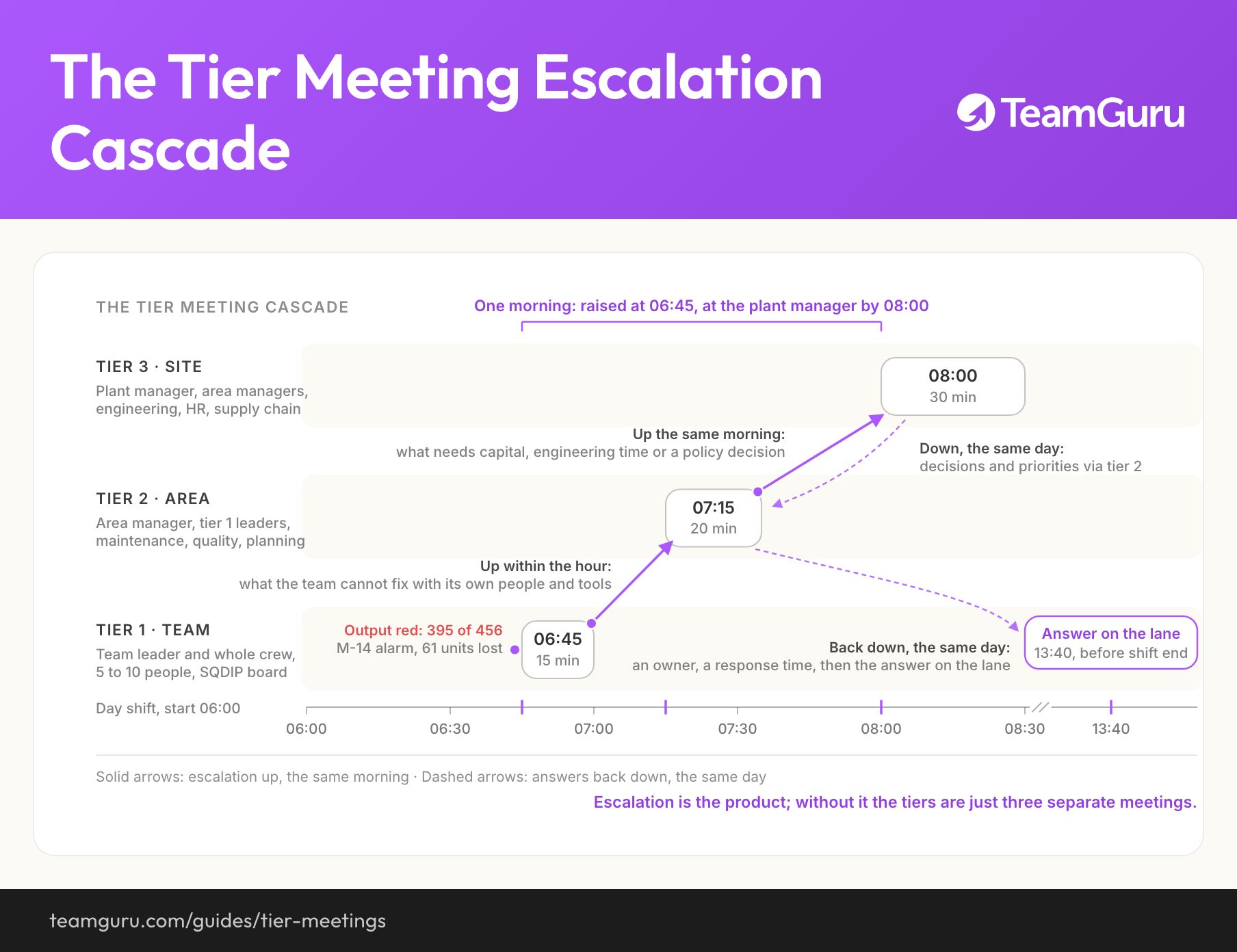
La cadena importa más que cualquier reunión aislada. Lo que un equipo no puede resolver sube esa misma mañana; lo que la dirección decide baja ese mismo día. Ese tráfico en dos sentidos, la escalación hacia arriba y las respuestas hacia abajo, es el producto real del sistema. Una planta que hace tres reuniones bien facilitadas sin una ruta de escalación entre ellas no tiene reuniones tier. Tiene tres reuniones separadas.
Nota de alcance: esta página cubre la cascada de reuniones en sí, las agendas, los horarios y las reglas de escalación. El tablero frente al que se paran las reuniones tiene su propia guía, tableros SQDIP, y el sistema operativo que las rodea, tableros más reuniones más rutinas de líder más resolución de problemas, se trata en gestión diaria lean.
La estructura de tres niveles de un vistazo
Esta es la forma estándar para una planta mediana con turno que arranca a las 6:00. Mueva los horarios según su propia hora de arranque y conserve los intervalos: cada nivel necesita de 20 a 30 minutos después del que tiene debajo, para que las escalaciones lleguen frescas y los líderes puedan caminar físicamente de un tablero a otro.
| Tier 1: equipo | Tier 2: área | Tier 3: sitio | |
|---|---|---|---|
| Quién asiste | Líder de equipo y toda la cuadrilla, de 5 a 10 personas | Gerente de área, los líderes de tier 1 y representantes de mantenimiento, calidad y planeación | Gerente de planta, gerentes de área, jefes de ingeniería, RR. HH. y cadena de suministro |
| Cuándo | 6:45, tras los primeros 45 minutos de un turno que arranca a las 6:00 | 7:15 | 8:00 |
| Duración | 15 minutos | 20 minutos | 30 minutos |
| Tablero que se usa | Tablero SQDIP del equipo, en la celda | Tablero de área: una fila por equipo, más el carril de escalación | Tablero del sitio: tendencias SQDIP, escalaciones principales, estatus de las contramedidas |
| Foco | Desviaciones de ayer, riesgos de hoy, acciones que el equipo asume | Solo rojos y escalaciones, apoyo interfuncional para hoy | Tendencias del sitio, conflictos de recursos, decisiones que requieren autoridad o dinero |
| Qué sube | Todo lo que el equipo no puede resolver con su propia gente y sus propias herramientas, dentro de la hora siguiente | Todo lo que requiere inversión, tiempo de ingeniería o una decisión de política interna | Nada. Aquí termina como decisión, como proyecto o como un no documentado |
| Qué baja | Una respuesta en el carril de escalación, a más tardar en la reunión de la mañana siguiente | Un responsable y un tiempo de respuesta para cada escalación aceptada, el mismo día | Decisiones y prioridades, que bajan a través de tier 2 el mismo día |
Las duraciones son techos. Un tier 1 que necesita más de 15 minutos está resolviendo problemas dentro de la reunión en lugar de asignarlos para después.
Dónde encajan las reuniones tier en la hoja de ruta de transformación
En la hoja de ruta de despliegue de TeamGuru las reuniones tier son el núcleo de la práctica de gestión diaria en la etapa «Gestionar el día a día»: son la forma en que el tablero SQDIP se convierte en una rutina de gestión en lugar de decoración de pared. Dan por hecho que ya existe una línea base de KPI, van en paralelo al trabajo estandarizado y a 5S, y crean la demanda de lo que sigue: el trabajo estándar del líder, para mantenerlas honestas, y la resolución estructurada de problemas, para atender lo que sacan a la luz.
Cuándo no está listo
Las reuniones tier son baratas de arrancar y caras de volver a arrancar. Una cascada lanzada antes de que existan los prerrequisitos se convierte en un recordatorio diario de que el sistema no funciona, y el segundo lanzamiento pelea contra esa memoria. No arranque cuando:
- Todavía no hay tableros de equipo. Una reunión tier es una conversación frente a un tablero; sin un tablero SQDIP que funcione y que traiga los números de ayer, la reunión se queda sin nada delante. Primero construya el tablero.
- No hay línea base de KPI. Si nadie sabe decir cómo se ve una producción, un scrap o un paro normales, todos los días son una desviación y ninguno lo es. Primero la línea base, después las reuniones.
- Los líderes no pueden asistir a diario. Si la agenda del gerente de área no puede proteger 20 minutos cada mañana, arregle la agenda antes de lanzar una cascada que se muere la primera semana en que el líder viaja.
- Los datos de ayer llegan al mediodía. Una reunión a las 6:45 sobre números que aparecen a las 12:00 es una reunión sobre anteayer. Arregle el flujo de datos hacia el tablero antes de arreglar la reunión.
Cómo lanzar la cascada
No lance una cascada para toda la planta un lunes. Lance una reunión, hágala buena y deje que cada nivel cree la demanda del siguiente. La secuencia de abajo lleva a un área típica de cero a una cascada de tres niveles funcionando en unas ocho semanas.
Semanas 1 y 2: un tier 1 en una sola área
Elija la celda con el tablero SQDIP más confiable y un líder dispuesto a ser el primero. Haga la reunión de 15 minutos todos los días laborables. El gerente de área asiste como coach, no como quien preside: la reunión la lleva el líder de equipo. Espere que la primera semana sea incómoda y que la segunda sea más corta.
Semanas 3 y 4: extienda tier 1 a toda el área y añada tier 2
Arranque los tableros de equipo restantes, sembrando cada reunión nueva con alguien que haya visto el piloto. Cuando al menos tres reuniones de tier 1 generen escalaciones de forma confiable, arranque la reunión de área de las 7:15. Tier 2 existe para responder a tier 1; si arranca antes, no tiene nada que hacer.
Semanas 5 a 8: extienda a otras áreas y luego añada tier 3
Repita el patrón área por área. Arranque la reunión del sitio solo cuando al menos dos áreas tengan un tier 2 estable. Un tier 3 alimentado por una sola área es una reunión de estatus con pasos adicionales.
Diseñe los horarios hacia atrás, desde la reunión del sitio
La regla es una sola mañana: una desviación levantada a las 6:45 debe poder llegar al nivel del sitio a las 8:00 del mismo día. Deje de 20 a 30 minutos entre niveles para que los líderes puedan caminar de un tablero a otro. Mueva toda la cascada con el arranque de su turno, pero conserve los intervalos.
Estandarice el formato en todas partes
La misma agenda, la misma distribución del tablero y el mismo carril de escalación en cada área, para que cualquier líder pueda leer cualquier tablero en diez segundos y la facilitación pueda rotar sin volver a capacitar a nadie.
El diseño de los horarios carga con todo el sentido de la cascada: la información levantada en un tablero de equipo a las 6:45 está en el nivel del sitio a las 8:00 de la misma mañana, y la respuesta puede estar de vuelta en el tablero del equipo antes de que termine el turno. Cualquier diseño en el que las escalaciones esperen a una reunión semanal ya perdió el día que se suponía que debía proteger.
Agendas minuto a minuto para tier 1 y tier 2
La agenda es la misma todos los días, en el mismo orden, para que la reunión funcione por ritmo y no por la energía del facilitador. Imprímala y cuélguela junto al tablero. Cuando un tema no cabe en la agenda, tampoco cabe en la reunión.
Tier 1: 15 minutos en el tablero del equipo
| Cuándo | Qué ocurre |
|---|---|
| Min 0 a 2 | Seguridad y personas: incidentes, casi accidentes, quién falta y cómo se cubre la línea hoy. |
| Min 2 a 7 | Recorrido del tablero: los datos reales de ayer frente a la meta SQDIP; cada letra la marca en verde o rojo el equipo, no el líder. |
| Min 7 a 12 | Desviaciones: por cada rojo, qué pasó, qué lo contiene hoy y una acción con responsable y fecha. En la reunión no se busca la causa raíz. |
| Min 12 a 14 | Escalaciones: lo que el equipo no puede resolver solo, escrito en el carril de escalación en una frase, con el impacto en piezas o en minutos. |
| Min 14 a 15 | Hoy: el plan, el mayor riesgo del día y la confirmación de que las acciones de ayer realmente se cerraron. |
Tier 2: 20 minutos en el tablero de área
| Cuándo | Qué ocurre |
|---|---|
| Min 0 a 2 | Seguridad en toda el área: lo que se haya levantado esta mañana en cualquier tablero de equipo, más las acciones de seguridad abiertas. |
| Min 2 a 8 | Equipo por equipo, de 60 a 90 segundos cada uno, por excepción: solo rojos y escalaciones. Un tablero en verde recibe un asentimiento, no un resumen. |
| Min 8 a 14 | Escalaciones nuevas: se acepta cada una con responsable y tiempo de respuesta, o se devuelve con un motivo que el equipo pueda entender. Nada se queda en el aire sin decisión. |
| Min 14 a 18 | Coordinación: las prioridades de mantenimiento, calidad y materiales para hoy en todos los equipos, de modo que las funciones de soporte salgan con una sola lista priorizada. |
| Min 18 a 20 | Escalaciones abiertas de días anteriores: estatus de cada punto y las respuestas que cada líder de tier 1 lleva de vuelta a su tablero. |
Fíjese en lo que ninguna de las dos agendas contiene: análisis de causa raíz, revisiones de proyectos o avisos generales. La reunión tier decide qué se desvió y quién actúa. Todo lo que necesita más de dos minutos de discusión sale de la reunión con un nombre y una hora asignados.
Reglas de escalación y tiempos de respuesta
La escalación falla de dos maneras opuestas: sube todo y los niveles superiores se ahogan, o no sube nada y los equipos conviven en silencio con problemas que no pueden resolver. La cura para ambas es la misma: reglas escritas que digan qué resuelve el equipo por sí mismo, qué debe subir y con qué rapidez baja la respuesta. La regla práctica: si la solución necesita a alguien que no está en la sala, el punto corresponde un nivel arriba.
| Regla | Qué aplica | El reloj |
|---|---|---|
| Lo resuelve el equipo | La causa se conoce y la solución solo necesita la gente, las herramientas y los estándares del propio equipo: un consumible faltante, un microparo aislado, un deterioro de 5S, una instrucción de trabajo que necesita una corrección que el equipo puede hacer. | Acción en el tablero el mismo día, con responsable nombrado, cerrada en menos de 24 horas. Si sigue abierta después de 24 horas, deja de ser un problema del equipo y sube. |
| Sube dentro de la hora | La solución necesita otra función (mantenimiento, calidad, planeación, ingeniería), cruza fronteras entre equipos, implica cualquier riesgo de seguridad, es la tercera vez que ocurre la misma desviación en dos semanas o ha mantenido un KPI en rojo más de dos días. | Se escribe en el carril de escalación durante tier 1 y se plantea en el tier 2 de esa misma mañana. Los riesgos de seguridad no esperan a una reunión: van al gerente de área de inmediato. |
| La respuesta baja | Cada escalación aceptada regresa al tablero del equipo con una de tres cosas: una solución, un plan con fecha o un motivo documentado de por qué no. El silencio no es una opción que el sistema permita. | Una respuesta provisional antes de que termine el mismo turno, y una respuesta definitiva o un plan con fecha en el tier 1 de la mañana siguiente. Ninguna escalación vive más de 48 horas sin responsable y sin fecha. |
Un detalle físico carga con casi toda la disciplina: el carril de escalación. Cada tablero, en cada nivel, tiene una franja visible donde viven las escalaciones con tres campos: qué, cuándo se levantó y cuándo se respondió. Una escalación que solo existe en una libreta o en una bandeja de correo ya fracasó, porque nadie puede verla envejecer.
Ejemplo resuelto: una desviación, un día
Las cifras son ilustrativas, pero coherentes entre sí, y usan el mismo fabricante de componentes de 450 personas que recorre la hoja de ruta de transformación: una demanda de 456 piezas al día, dos turnos, 54,000 segundos de tiempo de trabajo diario y un takt de 118 segundos. El turno de día arranca a las 6:00; cuatro equipos de producción hacen su tier 1 a las 6:45, el área se reúne a las 7:15 y el sitio a las 8:00. Esta es una desviación viajando por esa cascada.
6:45, tier 1 de maquinado
La fila de producción está en rojo: 395 piezas frente a 456. El equipo lo rastrea hasta tres paros por alarma de husillo en la máquina M-14, que suman 121 minutos; con un takt de 118 segundos, eso son 61 piezas perdidas. Los operadores reinician la alarma cada vez, pero no pueden diagnosticarla. Es el tercer día con la misma alarma.
6:52
Escalación escrita en el carril: alarma de husillo en M-14, tercer día, 121 minutos perdidos ayer, se necesita diagnóstico de mantenimiento hoy. La reunión termina a las 7:00 y el equipo vuelve a la línea.
7:15, tier 2 del área
El líder de maquinado reporta por excepción en 70 segundos. El gerente de área acepta la escalación, nombra responsable al planificador de mantenimiento y fija el tiempo de respuesta: diagnóstico antes de las 10:00 y respuesta en el tablero antes de que el turno termine a las 14:00.
8:00, tier 3 del sitio
M-14 aparece en el tablero del sitio como la escalación principal de maquinado. No necesita discusión: ya tiene responsable y reloj. El gerente de planta hace una sola pregunta: si resulta ser el husillo mismo, ¿hay refacción disponible?
9:40
Diagnóstico terminado. Un resorte del tirante desgastado está perdiendo fuerza de sujeción y dispara la alarma bajo carga. Hay refacción en almacén.
12:30
El resorte se cambia durante el descanso programado. Intervención total de 40 minutos, sin paro adicional.
13:40
El planificador de mantenimiento escribe la respuesta en el carril de escalación de maquinado antes de que termine el turno: causa encontrada, pieza cambiada, vigilar reincidencias esta semana.
A la mañana siguiente, 6:45
Sin paros de M-14, producción de vuelta en la meta, la fila está en verde. Como los reinicios ocultaron una pieza en falla durante dos días, tier 2 abre unos 5 porqués con el operador y el planificador: ¿por qué el equipo siguió reiniciando en lugar de escalar el primer día?
Tiempo total de reunión dedicado a este problema en los tres niveles: menos de cuatro minutos. La cascada no resolvió la alarma del husillo; la resolvió mantenimiento. Lo que la cascada aportó fue velocidad y certeza: el problema llegó a alguien que podía actuar 30 minutos después de haberse nombrado, llevaba un tiempo de respuesta desde el inicio, y la respuesta estaba de vuelta en el tablero del equipo antes de que terminara el turno, donde todos los que lo levantaron podían verla.
Cómo mantener honestas las reuniones tier
Toda reunión tier se degrada sin mantenimiento, y la degradación siempre va en la misma dirección: más larga, más sentada, más estatus, menos acciones. Tres prácticas sostienen el estándar:
- Trabajo estándar del líder: el gerente de área asiste a un tier 1 al día como observador, con una lista de verificación corta, y da coaching al facilitador después, nunca durante la reunión.
- Una auditoría mensual de la reunión: un líder de otra área califica la reunión con la lista de abajo y revisa el resultado con el facilitador ese mismo día.
- Facilitación rotativa: el rol de facilitador rota por el equipo cada una o dos semanas, para que la reunión sobreviva a las ausencias y a los ascensos, y para que cada integrante aprenda a llevar el tablero.
Las seis preguntas de auditoría
- ¿La reunión empezó a tiempo, de pie y frente al tablero?
- ¿Terminó dentro de su tiempo asignado?
- ¿Los datos de ayer estaban en el tablero antes de empezar?
- ¿Cada rojo tiene una acción con responsable y fecha?
- ¿Se escaló o se cerró explícitamente al menos un punto esta semana?
- ¿Cada escalación abierta recibió estatus y cada una respondida llegó al equipo?
Las verificaciones en sí pertenecen a las rutinas diarias de los líderes, que es justo lo que formaliza el trabajo estándar del líder: la asistencia, el coaching y las auditorías se vuelven trabajo programado y verificable en lugar de buenas intenciones.
Fallas más comunes
Las reuniones tier rara vez fracasan de forma ruidosa. Se erosionan, y la erosión sigue cuatro patrones predecibles. Cada uno tiene una contramedida que funciona mejor como regla permanente que como corrección puntual.
Se cuelan las diapositivas
Alguien arma una presentación para ahorrar tiempo y, en un mes, la reunión es sentada, proyectada y dura el doble. La contramedida es una regla, no un recordatorio: el tablero es el único medio. Si no está en el tablero, no está en la reunión.
El tier 2 de 45 minutos
La resolución de problemas se metió en la reunión. La reunión identifica, asigna y verifica; resolver ocurre después, solo con la gente necesaria. Dele al facilitador permiso explícito para decir «eso lo vemos después» y ponga un reloj visible junto al tablero.
Las escalaciones desaparecen en las libretas
Un supervisor anota el problema en una libreta y la libreta se va a la oficina. Una escalación existe solo en el carril, con la fecha en que se levantó y la fecha en que se respondió, ambas visibles. Todo lo que tenga más de 48 horas sin responsable entra automáticamente en la agenda del siguiente tier 2.
La asistencia se cae a partir del segundo mes
Los líderes empiezan a mandar suplentes y luego disculpas. La asistencia es trabajo estándar del líder y se verifica como cualquier otro estándar. Pero trate la caída como un síntoma: la gente deja de venir cuando las escalaciones dejan de volver respondidas. Audite la tasa de respuesta antes de auditar la asistencia.
Qué sigue
Una cascada que funciona saca a la luz más problemas de los que puede arreglar con acciones del mismo día, y eso es intencional. Las desviaciones que se repiten, la misma alarma, el mismo defecto, el mismo faltante, salen de la reunión hacia la resolución estructurada de problemas: unos 5 porqués para las simples y un ciclo completo de análisis de causa raíz y acciones correctivas para las que siguen volviendo. La reunión tier sigue siendo el lugar donde esas contramedidas reportan avance, lo que cierra el ciclo entre la gestión diaria y la mejora.
Lo difícil de sostener todo esto no es la disciplina, es la administración: cientos de escalaciones, acciones y respuestas pequeñas al mes, cada una con su responsable, su fecha y su estatus visible. Ahí es donde TeamGuru encaja en la práctica: los casos de uso de reuniones estandarizadas, gestión de KPI y escalación de problemas mantienen el KPI, la discusión, la acción, el responsable y la escalación en un solo hilo, de modo que un punto levantado en tier 1 lleva su historial consigo hasta tier 2 y la respuesta baja por el mismo camino, visible para el equipo que lo levantó.
En la hoja de ruta, las prácticas siguientes son el trabajo estándar del líder, que convierte asistir a la cascada, dar coaching y auditarla en parte de la rutina diaria verificada de cada líder, y la resolución estructurada de problemas, que convierte lo que la cascada saca a la luz en causas raíz realmente eliminadas.
Lléveselo consigo
El diagrama de esta guía como imagen, de uso libre en formaciones internas y talleres.
Descargar PNGPreguntas frecuentes
¿Cuántos niveles necesita una planta?
¿Cuánto debe durar una reunión tier?
¿Las reuniones tier deben ser de pie o sentadas?
¿Qué corresponde a tier 1 y qué a tier 2?
¿Cómo evitamos que las reuniones tier mueran a los pocos meses?
¿Funcionan las reuniones tier en equipos remotos o con varios sitios?
Cómo lo lleva a la práctica TeamGuru