Guía de implementación
Matriz de habilidades.
Una matriz de habilidades (skills matrix) es una cuadrícula visible que muestra quién puede operar cada estación, y con qué nivel de calificación, en un equipo o área. Registra la capacidad demostrada en el proceso, no la asistencia a cursos: una lista firmada dice que alguien estuvo en un salón; un nivel dice quién opera la estación solo, al takt y según el estándar. También es un plan: las brechas que hace visibles son la capacitación cruzada del próximo trimestre.
Qué es una matriz de habilidades
Una matriz de habilidades (skills matrix) es una cuadrícula con las estaciones y las habilidades críticas de un área en un eje, las personas del equipo en el otro y un nivel de calificación en cada celda. En España la misma herramienta se llama matriz de polivalencia, y en Recursos Humanos, matriz de competencias; la mecánica es la misma. De un vistazo responde las dos preguntas que cada supervisor enfrenta a diario: quién puede operar cada estación en este momento y dónde el equipo está a una sola ausencia de tener un problema.
La matriz tiene dos funciones. Hoy es una herramienta de operación: la decisión de asignación de la mañana, la aprobación de vacaciones, la respuesta a dos personas que se reportan enfermas. A lo largo del trimestre es un plan de desarrollo: cada brecha frente a las reglas de cobertura del equipo se convierte en una entrada de capacitación cruzada con instructor y fecha. Casi todas las plantas tienen expedientes de capacitación. Muy pocas pueden responder, a las 6:10 de un lunes y con dos personas ausentes, quién está calificado para operar la prueba final sin ayuda.
Una sola definición sostiene todo el método: una habilidad en la matriz es la capacidad de ejecutar un estándar documentado, evaluada por observación en el proceso. Ese anclaje es lo que hace que un nivel signifique lo mismo en los dos turnos, y es lo que separa una matriz de habilidades de una lista de cursos a los que alguien asistió alguna vez.
Dónde encaja la matriz de habilidades en la hoja de ruta
En la hoja de ruta de despliegue de TeamGuru la matriz de habilidades es una práctica propia dentro de la etapa «Escalar»: matriz de habilidades y desarrollo de capacidades. Está ahí porque el desarrollo sistemático de capacidades es lo que permite a una planta extender su sistema de gestión sin diluirlo. Aun así, no espere a la etapa «Escalar» para empezar. Una matriz básica se gana su lugar en cuanto existe el trabajo estandarizado, porque los estándares definen qué habilidades vale la pena evaluar. Y el sistema diario la consume cada mañana: la decisión de cobertura del tier 1 en la gestión diaria lean es una lectura de la matriz.
- Antes Gestión diaria
- Está aquí Matriz de habilidades y capacidades
- En paralelo Obeya y revisiones de dirección
- Después Estandarizar y escalar
Por qué falla el registro de asistencia
Lo habitual en la mayoría de las plantas es una matriz de capacitación en un sistema de Recursos Humanos: cursos completados, certificados emitidos, firmas recogidas. Existe porque las auditorías la piden, y responde la pregunta que hacen los auditores: ¿estuvo esta persona expuesta a la capacitación? No puede responder la pregunta que hace producción: ¿puede esta persona hacer el trabajo? Las dos preguntas se separan de tres formas previsibles.
- La asistencia no es desempeño. Una lista firmada dice que alguien estuvo en un salón durante cuatro horas. No dice nada sobre si puede operar la estación al takt, solo, en todas las variantes y en un mal día. La distancia entre esos dos estados son semanas de práctica supervisada, y el registro de asistencia no ve nada de eso.
- Las habilidades se deterioran y el registro no. Quien se capacitó hace tres años y no ha tocado la estación desde entonces sigue apareciendo como capacitado. El papel se mantiene en verde mientras la capacidad caduca en silencio.
- Esconde el riesgo de cobertura. Un reporte que dice que el 100 por ciento del equipo está capacitado parece seguro, mientras que en realidad una sola persona es la única que puede operar de forma autónoma una estación crítica. El promedio esconde justo el punto único de falla que el supervisor más necesita ver.
Registrar la capacidad demostrada cuesta más que archivar certificados: alguien tiene que observar el trabajo real, registrar la evidencia y revisar los niveles cuando vencen. Ese costo es la diferencia entre un adorno de pared y una herramienta que decide la asignación de personal. Conserve los expedientes de capacitación para los auditores. Dirija la línea con la matriz.
Los cuatro niveles de calificación
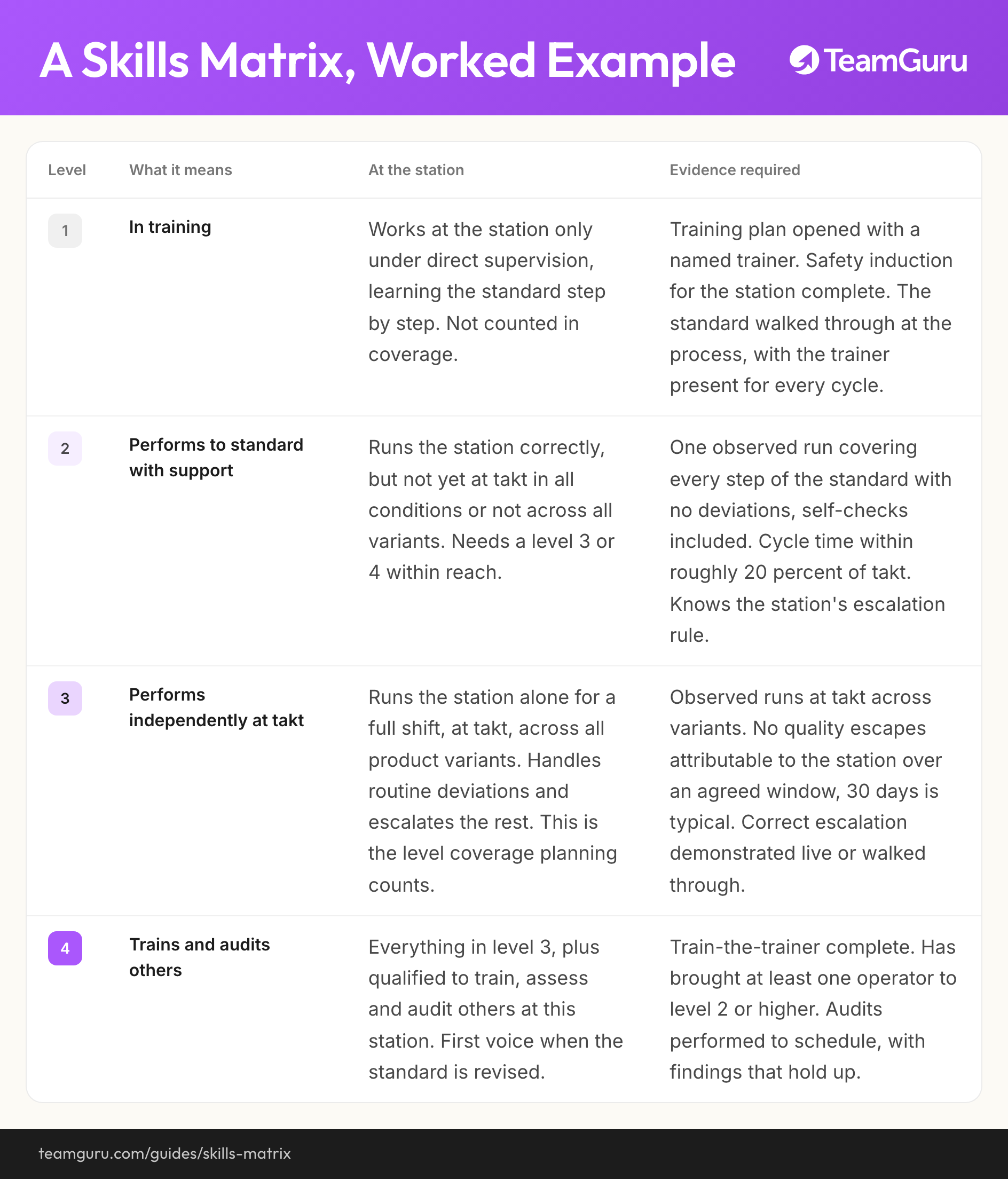
Cuatro niveles bastan. Una escala más fina da sensación de precisión y no evalúa nada más. Lo que da sentido a la escala es la columna de evidencia: un nivel se otorga cuando la evidencia existe, en el proceso, y no antes.
| Nivel | Qué significa | En la estación | Evidencia requerida |
|---|---|---|---|
| 1 | En capacitación | Trabaja en la estación únicamente bajo supervisión directa, aprendiendo el estándar paso a paso. No cuenta para la cobertura. | Plan de capacitación abierto con un instructor designado por su nombre. Inducción de seguridad de la estación completada. El estándar recorrido en el proceso, con el instructor presente en cada ciclo. |
| 2 | Trabaja según el estándar con apoyo | Opera la estación correctamente, pero todavía no al takt en todas las condiciones o no en todas las variantes. Necesita tener cerca a un nivel 3 o 4. | Una corrida observada que cubre todos los pasos del estándar sin desviaciones, autocontroles incluidos. Tiempo de ciclo dentro de aproximadamente el 20 por ciento del takt. Conoce la regla de escalación de la estación. |
| 3 | Opera de forma autónoma al takt | Opera la estación solo durante un turno completo, al takt y en todas las variantes de producto. Resuelve las desviaciones de rutina y escala el resto. Este es el nivel que cuenta en la planificación de cobertura. | Corridas observadas al takt en todas las variantes. Sin escapes de calidad atribuibles a la estación durante una ventana acordada, 30 días es lo habitual. Escalación correcta demostrada en vivo o recorrida paso a paso. |
| 4 | Capacita y audita a otros | Todo lo del nivel 3, más la calificación para capacitar, evaluar y auditar a otros en esta estación. Primera voz cuando se revisa el estándar. | Formación de instructores (train-the-trainer) completada. Ha llevado al menos a un operador al nivel 2 o superior. Auditorías realizadas según el calendario, con hallazgos que se sostienen. |
Algunas empresas dibujan la misma escala como círculos rellenados en cuartos sobre la pared. La notación no importa. La evidencia sí, y también la regla de que solo el nivel 3 y superiores cuentan como cobertura.
Cómo construir una matriz que la línea use de verdad
Una primera matriz para un equipo toma unas dos semanas: un día para definir las habilidades, una o dos semanas de observación para levantar la línea base con honestidad y una hora para hacerla visible. La secuencia importa más que la herramienta.
Liste las habilidades a partir del trabajo estandarizado, no de los puestos
Cada fila de la matriz es un estándar contra el cual se puede evaluar a alguien: una estación, un cambio de modelo, una verificación crítica. Si no existe un estándar, no hay nada objetivo que evaluar, así que escriba primero el estándar. Denominaciones de puesto como operador de máquina esconden justo las diferencias que la matriz existe para mostrar.
Acótela a un solo equipo
Las estaciones y las personas de un área en una sola cuadrícula, más unas pocas habilidades compartidas que el equipo realmente usa: montacargas, primera respuesta, compuerta de calidad. Manténgala entre cinco y doce habilidades. Una matriz de toda la planta mantenida de forma centralizada es un reporte; una matriz de equipo en la pared es una herramienta.
Levante la línea base con honestidad, por observación
Un evaluador calificado observa a cada persona trabajando contra el estándar y califica lo que ve, no lo que dice el expediente de capacitación. Espere que la línea base salga más baja de lo que todos suponían. Eso no es un insulto, es el hallazgo, y es la razón por la que el ejercicio se paga solo.
Otorgue los niveles en el proceso, con evidencia
El supervisor y un instructor calificado evalúan juntos, en la estación, contra los criterios escritos de cada nivel. La evidencia se registra: qué se observó, cuándo y quién lo observó. Un nivel que nadie puede rastrear hasta una observación es una opinión con un número encima.
Hágala visible en el área
La matriz cuelga junto al tablero del equipo, o está en la misma pantalla, donde las personas que describe puedan verla. Manténgala fuera de la conversación anual de sueldos, al menos el primer año, o cada nivel se convertirá en una negociación en lugar de una evaluación.
La línea base honesta es el paso que los equipos más quieren saltarse, y el que decide si la matriz se gana la confianza. Si la primera versión de la cuadrícula halaga a todos, la primera ausencia que salga mal la deja en evidencia, y la herramienta muere en un mes. Evalúe lo que pueda observar y deje que la pared muestre un panorama más duro que el de los expedientes de capacitación.
Ejemplo resuelto: una celda, seis operadores
Las cifras son ilustrativas pero coherentes entre sí, y usan el mismo fabricante de componentes de 450 personas que recorre la hoja de ruta de transformación: 456 unidades por día, dos turnos y un takt de 118 segundos. La celda de montaje opera cinco estaciones con seis operadores por turno. Esta es la matriz del turno de día después de una línea base honesta por observación.
| Estación | Op. A | Op. B | Op. C | Op. D | Op. E | Op. F | Nivel 3+ |
|---|---|---|---|---|---|---|---|
| Submontaje | 4 | 3 | 2 | 3 | 1 | 2 | 3 |
| Soldadura | 3 | 4 | 1 | - | 2 | - | 2 |
| Montaje principal | 3 | 3 | 3 | 2 | 2 | 1 | 3 |
| Ajuste y torque | 2 | 3 | 4 | - | - | 2 | 2 |
| Prueba final riesgo de cobertura | - | 2 | 3 | - | - | 1 | 1 |
La regla de cobertura de la celda es un mínimo de dos operadores en nivel 3 o superior para cada estación crítica en cada turno. Cuatro estaciones la cumplen. La prueba final no: el Op. C es la única persona que puede operarla de forma autónoma. El Op. A, que cubre otras tres estaciones en nivel 3 o superior, no puede operarla en absoluto. Cada vez que C se ausenta, la prueba final corre en nivel 2 con apoyo, lo que saca al líder de equipo del coaching durante todo el día y deja la última verificación antes del embarque en su configuración más débil.
La matriz convierte ese riesgo en dos entradas del plan de capacitación cruzada del próximo trimestre. El Op. B pasa de nivel 2 a nivel 3 en la prueba final: dos bloques protegidos de práctica por semana con C al lado y evaluación en el proceso al cierre del trimestre. El Op. C pasa de nivel 3 a nivel 4: formación de instructores, para que la celda tenga instructor propio en lugar de pedirlo prestado. Las dos entradas llevan nombre y fecha, y las dos se revisan cada mes como cualquier otra acción. Ese es el método completo: la matriz encuentra el riesgo, el plan lo cierra y la revisión comprueba que ocurrió.
Usar la matriz para planificar cobertura y capacitación cruzada
Una matriz sin reglas de decisión es un tablero de inspiración. Acuerde las reglas de cobertura una vez, escríbalas junto a la cuadrícula y haga que cada revisión compare la cuadrícula contra ellas. Un conjunto inicial que funciona:
- Mínimo dos operadores en nivel 3 o superior para cada estación crítica, en cada turno. Uno solo es un punto único de falla con nombre y apellido.
- Cada operador en nivel 3 o superior en al menos dos estaciones, para que la rotación y la cobertura de ausencias sean opciones reales, no favores.
- Al menos un nivel 4 por estación en algún punto del sitio, para que el equipo desarrolle su propia capacidad en vez de pedir instructores prestados.
- Cada persona de nuevo ingreso alcanza el nivel 2 en una primera estación dentro de una ventana acordada, típicamente de cuatro a ocho semanas, y la matriz muestra quién va retrasado.
La capacitación cruzada cuesta capacidad, y por eso muere cuando se deja para los momentos tranquilos: no hay momentos tranquilos. Prográmela como el mantenimiento, en espacios protegidos del plan de producción, con la persona en formación emparejada a un nivel 4 y la práctica contada como trabajo, no como un favor. Un plan que solo corre cuando el día sale bien no es un plan.
La cadencia: el supervisor es dueño de la matriz y la actualiza el mismo día en que se otorga o vence un nivel. Una vez al mes, la matriz sube al nivel de sitio de la cascada de reuniones tier: brechas frente a las reglas de cobertura, avance del plan de capacitación cruzada y recalificaciones próximas a vencer. Las evaluaciones y las auditorías de calificación que mantienen honestos los niveles pertenecen al trabajo estándar del líder, para que ocurran por rutina y no por memoria.
Polivalencia, rotación y rutas de desarrollo
La misma cuadrícula que gestiona el riesgo gestiona también la monotonía. La rotación entre estaciones rompe la carga repetitiva y mantiene fresca la atención en las verificaciones de calidad, pero solo es segura cuando la matriz muestra niveles 3 reales en cada posición del circuito. La rotación también protege los propios niveles: una habilidad que nunca se practica es un nivel 3 que se convierte en silencio en un nivel 2 que la pared sigue mostrando en verde.
Para las personas que aparecen en ella, la matriz es la ruta de desarrollo más concreta que ofrece la planta: el camino del nivel 1 al nivel 4 en una estación, y de dos estaciones a cinco, es visible, evaluable y público. El nivel 4 merece tratarse como un rol de experto reconocido, porque de ahí salen los próximos instructores y líderes de equipo de la planta. Un indicador de tendencia simple ayuda: el número promedio de estaciones por operador en nivel 3 o superior. Observe su dirección trimestre a trimestre y resista la tentación de convertirlo en meta, porque la matriz existe precisamente para ver más allá de los promedios.
Fallos habituales
Las matrices de habilidades rara vez fallan como idea. Fallan como práctica, de cuatro formas recurrentes, y cada una tiene una contramedida que funciona mejor como regla permanente que como arreglo puntual.
La hoja de cálculo que vive en Recursos Humanos
La matriz está en una carpeta compartida, se actualiza una vez al año para la auditoría y nadie en la línea la ha visto nunca. La propiedad es del equipo y de su supervisor: la matriz cuelga en el área y cambia el mismo día en que cambia un nivel, o es un registro, no una herramienta.
Niveles inflados para pasar auditorías
La semana antes de una auditoría de cliente, todos se vuelven nivel 3. Los niveles inflados convierten la planificación de cobertura en ficción y afloran como escapes de calidad en la estación que alguien supuestamente podía operar solo. La contramedida es evidencia por nivel, evaluación en el proceso y auditorías puntuales de las calificaciones, como con cualquier otro estándar.
Niveles que nunca caducan
Un nivel otorgado en 2022 sigue contando, aunque el operador no haya tocado la estación desde entonces. Las habilidades se deterioran; una matriz sin recalificación no puede verlo. Dé a cada habilidad una fecha de vencimiento, más corta para las habilidades críticas y para las que se ejecutan pocas veces, y deje que la matriz marque a quien vaya retrasado.
Una matriz sin plan de capacitación
La cuadrícula está al día, es honesta y está visible, y las mismas brechas siguen ahí trimestre tras trimestre. Una matriz que no genera un calendario es una foto bien cuidada de un problema. Cada brecha frente a las reglas de cobertura se convierte en una entrada de capacitación cruzada con fecha e instructor designado, revisada cada mes.
Qué pasa después
En la hoja de ruta, la matriz es la forma en que la práctica de desarrollo de capacidades deja de ser una intención. Cada práctica construida en las etapas anteriores (tableros, trabajo estandarizado, resolución de problemas, auditorías) necesita personas calificadas para ejecutarla, y escalar cualquiera de ellas a una segunda área o a un segundo sitio es una cuestión de capacidades antes que una cuestión de despliegue. Las plantas maduras extienden la misma cuadrícula más allá de las habilidades de producción, hacia las habilidades del sistema de gestión: dirigir una reunión tier, acompañar un caso de resolución de problemas, auditar un estándar. La mecánica es idéntica: un estándar definido, desempeño observado, evidencia y vencimiento.
La parte difícil de sostener una matriz es llevar la cuenta: niveles, evidencia, fechas de vencimiento y acciones de capacitación en varios equipos y turnos, cambiando cada semana. La versión de pared es la correcta para el equipo y la equivocada como copia única, porque el papel no puede marcar una calificación por vencer ni conectar una brecha con una acción programada. Aquí es donde TeamGuru encaja en la práctica: el caso de uso de gestión de la matriz de habilidades mantiene la matriz viva, con evidencia detrás de cada nivel, fechas de vencimiento que se señalan solas y cada brecha ligada a una acción de capacitación con fecha, para que la decisión de cobertura de la mañana y la revisión trimestral de capacidades lean los mismos datos que la hoja de ruta pide cerrar.
Lléveselo consigo
El diagrama de esta guía como imagen, de uso libre en formaciones internas y talleres.
Descargar PNGPreguntas frecuentes
¿Qué significan los niveles de una matriz de habilidades?
¿Quién evalúa y otorga los niveles de habilidad?
¿Con qué frecuencia deben recalificarse los operadores?
¿La matriz debe cubrir un equipo o toda la planta?
¿Cuál es la diferencia entre una matriz de habilidades y una matriz de capacitación?
¿Cómo se manejan los productos nuevos o las estaciones nuevas?
Cómo lo lleva a la práctica TeamGuru