Guide de mise en œuvre
Analyse des causes racines et actions correctives (RCCA).
La démarche RCCA conduit un problème de la détection à une correction définitive et vérifiée : décrire précisément, sécuriser, trouver la cause avec des preuves, la supprimer, puis confirmer par les données, des semaines plus tard, que le problème n'est pas revenu. L'échec le plus courant est silencieux : la sécurisation devient la correction et le dossier se clôt. Un dossier se termine à la vérification d'efficacité, pas à la mise en œuvre.
Ce qu'est la démarche RCCA, et ce qu'elle apporte
Le RCCA n'est pas un outil, c'est une façon de tenir un dossier. Il fait passer un problème par une séquence fixe : décrire l'écart avec précision, protéger le client pendant le travail, analyser la cause avec des preuves, supprimer cette cause, vérifier que la correction est bien en place, puis, 30 à 60 jours plus tard, confirmer par les données que le problème n'est pas revenu. Deux règles tiennent l'ensemble : une cause se vérifie, elle ne se vote pas, et un dossier se clôt sur l'efficacité, pas sur l'effort.
L'analyse, à l'intérieur du dossier, est le plus souvent une chaîne de 5 pourquoi, précédée d'un diagramme d'Ishikawa quand plusieurs causes candidates se disputent la place. Ce que la démarche RCCA ajoute autour de ces outils, c'est du management : un énoncé de problème sur lequel on peut réellement travailler, une sécurisation qui reste visiblement distincte de la correction, des actions avec un responsable et une échéance, et une vérification d'efficacité programmée le jour de l'ouverture.
Le vocabulaire compte, parce que les trois types d'action se confondent tous les jours : la sécurisation protège le client tant que la cause est inconnue, l'action corrective supprime la cause vérifiée, l'action préventive supprime la même cause là où elle n'a pas encore fait de dégâts. Le tableau comparatif plus bas fait passer les trois par un même dossier de défaut.
La place du RCCA dans la feuille de route de transformation
Sur la feuille de route de déploiement TeamGuru, la démarche RCCA est le cœur de la pratique résolution structurée de problèmes, au stade de pilotage quotidien. Elle consomme le flux d'écarts que fait remonter le management quotidien de la performance : chaque rouge qui revient sur un tableau AIC est un dossier potentiel. Sur l'échelle de la résolution de problèmes, elle occupe le milieu : un 5 pourquoi debout devant le tableau traite l'écart du jour, un A3 apporte la profondeur et l'accompagnement qu'exigent les problèmes chroniques, et le format 8D habille la même discipline pour le client. Le RCCA est la logique de dossier qu'ils partagent tous.
- Avant Management quotidien
- Vous êtes ici Résolution structurée de problèmes
- Après Kaizen
- Après Obeya et revues de direction
Quand la rigueur complète paie, et quand elle ne paie pas
La rigueur du RCCA coûte cher : des heures d'ingénierie, du temps sur le terrain, des semaines de suivi. Dépensez-la là où l'enjeu le justifie. Un écart isolé et sans conséquence, dont la cause saute aux yeux, mérite une correction et une ligne de compte rendu, pas un dossier en sept étapes. Gardez la discipline pour les problèmes qui reviennent, qui coûtent vraiment de l'argent ou qui touchent le client, et adaptez le format à la situation :
- Écart isolé, peu coûteux, cause évidente : corrigez, notez-le sur le tableau AIC, passez à la suite. Pas de dossier.
- Problème qui revient sur le tableau, qui coûte cher, ou qui touche plusieurs équipes ou plusieurs secteurs : ouvrez un dossier RCCA.
- Réclamation client ou défaut parti chez le client : la même rigueur, mais au format 8D que le client attend.
- Événements sécurité : rigueur complète à chaque fois, jamais un 5 pourquoi improvisé dans un couloir.
L'autre moitié du travail consiste à limiter l'en-cours. Un ingénieur avec cinq dossiers ouverts n'en clôt aucun : le registre devient du papier peint. Deux ou trois dossiers vivants par responsable, qui avancent chaque semaine, valent mieux qu'un stock qui prouve le sérieux du site en matière de qualité sans rien résoudre.
Mener un dossier RCCA
Le déroulé ci-dessous, c'est toute la méthode. Chaque étape a son critère de sortie, et la discipline consiste à refuser de passer à la suivante tant qu'il n'est pas rempli. Les processus RCCA qui ne fonctionnent pas n'ont presque jamais une étape en moins : ils sautent des critères de sortie, en général entre l'étape 5 et l'étape 6.
| Étape | Le travail | Critère de sortie |
|---|---|---|
| 1. Détecter et décrire | Transformez l'écart en énoncé de problème : quoi, où, quand, combien, et ce que le problème n'est pas. Les premières données se relèvent au poste, pas dans les souvenirs de chacun. | Un énoncé exploitable par quelqu'un d'extérieur, chiffré par rapport au standard, qui dit ce que le problème est et ce qu'il n'est pas. |
| 2. Sécuriser | Protégez le client et les postes en aval : tri, contrôle renforcé, retouche, stock suspect bloqué et repassé. | Plus aucune pièce défectueuse ne peut sortir, le coût journalier de la sécurisation est chiffré, une date de levée est fixée. |
| 3. Analyser la cause | Un Ishikawa pour cartographier les causes candidates s'il y en a plusieurs, puis une chaîne de 5 pourquoi sur la plus solide. Vérifiez chaque réponse au poste avant de poser le pourquoi suivant. | La cause est confirmée par la preuve ou par reproduction : on la remet, le problème revient ; on l'enlève, il disparaît. |
| 4. Action corrective | Concevez des actions qui suppriment la cause vérifiée, pas le symptôme. Chaque action a un seul responsable et une échéance. | Actions définies, dotées des moyens nécessaires et acceptées par ceux qui vont vivre avec. |
| 5. Vérifier la mise en œuvre | Allez constater au poste que la nouvelle méthode, le nouveau dispositif ou le nouveau standard existe et qu'il est réellement appliqué dans toutes les équipes. | Un audit de mise en œuvre au poste est concluant. Ce n'est pas encore la clôture. |
| 6. Vérification d'efficacité | Suivez pendant 30 à 60 jours le signal qui a détecté le problème, assez longtemps pour couvrir les équipes, les lots matière et le mix produit. | Récurrence au niveau convenu ou en dessous, confirmée par les données. La sécurisation se lève ici, pas avant. |
| 7. Standardiser | Mettez à jour le travail standardisé, formez dessus, et regardez si les process voisins portent la même cause. | Un standard modifié, une formation tracée, les process voisins passés en revue. Maintenant le dossier se clôt. |
Commencez par l'énoncé du problème
Un dossier qui démarre sur « ça fuit encore » finit en suppositions. Un énoncé utilisable répond à quoi, où, quand et combien, et dit ce que le problème n'est pas. Chez le fabricant de composants de 450 personnes qui sert d'exemple sur tout le site (456 pièces par jour, deux équipes), avec des chiffres illustratifs : le raccord hydraulique F-218 fuit au test final. Ligne 2 uniquement, les deux équipes, première apparition en semaine 32. Sur deux semaines, 62 pièces sur 4 560 ont été rejetées, soit 1,4 % de la production. Est : le raccord F-218 sur la ligne 2. N'est pas : le même raccord sur la ligne 1, ni les autres raccords de la même pièce. Cette frontière est / n'est pas élimine déjà la plupart des causes candidates avant que personne n'ait posé le premier pourquoi.
Vérifiez la cause par la preuve
L'équipe a audité le couple de serrage sur 30 pièces rejetées : 26 étaient en dessous de la spécification du plan. La chaîne de pourquoi a mené au mode opératoire de la ligne, qui portait encore la valeur de couple d'avant une évolution de définition. Les opérateurs de la ligne 2 appliquaient leur standard à la lettre, et c'est le standard qui était faux. La cause a ensuite été vérifiée par reproduction : les assemblages serrés à la valeur du mode opératoire fuyaient au test de pression, ceux serrés à la valeur du plan ne fuyaient pas. Cause remise, le défaut revient ; cause retirée, il disparaît : c'est cela, une preuve. Une cause sur laquelle trois managers se mettent d'accord en salle de réunion est une hypothèse, pas un résultat.
Des actions avec un responsable et une échéance
L'action corrective vise la cause vérifiée, et chaque action a exactement un responsable et une date. Ici : la valeur de couple corrigée dans le travail standardisé, avec formation des deux équipes (superviseur de production, une semaine), et l'installation d'une visseuse à comptage Poka-Yoke qui ne libère le cycle que lorsque les deux fixations ont atteint la valeur cible (ingénieur méthodes, trois semaines). Des actions dont le responsable est « l'équipe » et l'échéance « dès que possible », c'est le dossier qui vous annonce qu'il ne se clôturera pas.
Le piège de la sécurisation
La sécurisation est l'étape la plus séduisante du RCCA, parce qu'elle marche tout de suite. Le tri démarre, le contrôle supplémentaire est en place, le client arrête d'appeler, et l'indicateur qui avait rendu le problème visible repasse au vert. Tous les signaux qui poussaient le dossier disent maintenant que c'est fini. C'est le premier mode de défaillance du RCCA : la pression retombe, l'équipe retourne à son quotidien, et la sécurisation devient tranquillement la correction. Si le dossier se clôt là, le problème n'est pas résolu, il est seulement reporté. Il reviendra au prochain changement d'équipe, au prochain lot matière ou à la prochaine semaine chargée, et pendant ce temps la facture tourne : un contrôle supplémentaire de 25 secondes sur 456 pièces par jour, cela fait plus de trois heures de contrôle par jour, tous les jours, sans date de fin.
| Type d'action | Ce qu'elle fait | Le dossier du raccord qui fuit | Ce qu'elle ne fait pas |
|---|---|---|---|
| Action de sécurisation | Protège le client tant que la cause reste inconnue. Tri, contrôle renforcé, quarantaine, retouche. | Contrôle d'étanchéité à 100 % au poste de montage du raccord, trois jours de produits finis mis en quarantaine et repassés au banc. | Stoppe l'hémorragie et ne répare rien. Coûte de l'argent chaque jour, et elle tourne jusqu'à ce que l'étape 6 confirme que la correction tient. |
| Action corrective | Supprime la cause vérifiée pour que le défaut cesse d'apparaître sur ce process. | Couple de serrage corrigé dans le travail standardisé, plus une visseuse à comptage qui ne libère le cycle que lorsque les deux fixations ont atteint la valeur cible. | Empêche la récurrence ici. Ne dit rien de la même cause ailleurs. |
| Action préventive | Supprime la même cause là où elle n'a pas encore fait de dégâts. | Revue AMDEC des raccords similaires sur l'ensemble des produits ; la visseuse à comptage déployée sur deux postes jumeaux qui montent le même raccord. | Les défauts les moins chers sont ceux qui n'arrivent jamais. C'est pourtant l'étape la plus souvent sautée. |
Deux règles gardent la sécurisation honnête. D'abord, elle reçoit un coût journalier et une date de levée le jour où elle démarre ; ce coût devient l'argument budgétaire de l'action corrective. Ensuite, seule la vérification d'efficacité peut la lever. Lever la sécurisation parce que les chiffres sont bons deux semaines après la correction, c'est la façon de laisser échapper deux fois le même défaut.
La vérification d'efficacité : c'est là que le dossier se gagne
Une vérification d'efficacité, c'est simple : suivre au poste, pendant 30 à 60 jours, le signal qui a détecté le problème. La fenêtre doit être assez longue pour couvrir les deux équipes, plusieurs lots matière et le mix produit habituel, parce que ce sont exactement ces variations qui ressuscitent les problèmes à moitié résolus. Elle est confiée à quelqu'un qui n'est pas responsable des actions, en général un ingénieur qualité ou le responsable de secteur, et elle est programmée à l'ouverture du dossier, pas le jour où quelqu'un y repense.
Dans le dossier du raccord : 45 jours après la mise en œuvre, six semaines consécutives de production sur les deux équipes n'ont donné aucune fuite du F-218 au test final. Le contrôle à 100 % au poste a été levé, le stock en quarantaine avait été traité depuis longtemps, et le dossier a été clos. Quand une vérification échoue, rouvrez sans état d'âme. Une vérification d'efficacité qui échoue, c'est la méthode qui fonctionne : elle a attrapé une cause fausse ou partielle avant que le problème ne soit rebaptisé « normal ». Le seul vrai échec, c'est de sanctionner la réouverture au point que plus personne ne programme de vérification honnête.
Suivre la récurrence : le KPI de tout le système
Un seul chiffre dit si votre système de résolution de problèmes fonctionne : le taux de récurrence, la part des dossiers clos dont le problème revient dans les 12 mois. Suivez-le chaque mois, à côté de l'ancienneté des dossiers ouverts. Un taux de récurrence élevé veut dire que les causes ne sont pas vérifiées, ou que les dossiers se closent à la mise en œuvre ; une ancienneté qui monte veut dire que le flux est saturé. Les deux ont leur place dans le socle de KPI du site, parce que compter les dossiers ouverts récompense l'activité, alors que compter les problèmes qui ne sont pas revenus récompense la seule chose qui compte.
Erreurs fréquentes
Ce qui montre que ça ne marche pas
- Le dossier se clôt le jour où les actions sont mises en place, et plus personne n'y revient
- Cause racine consignée comme « erreur opérateur », contre-mesure consignée comme « recyclage de l'opérateur »
- Une sécurisation qui tourne depuis des mois, sans coût chiffré ni date de levée
- Cinq dossiers ouverts par ingénieur, aucun qui avance : le registre existe pour être montré aux auditeurs
- La correction fonctionne, mais aucun standard ne change, et le prochain embauché reconstruit le problème
Ce qui montre que ça marche
- Des énoncés de problème avec quoi, où, quand, combien, est et n'est pas
- Des causes vérifiées par reproduction ou par des données mesurées au poste
- La vérification d'efficacité programmée à l'ouverture, confiée hors de l'équipe des actions
- Une sécurisation qui porte un coût journalier et que seule la vérification d'efficacité peut lever
- Chaque dossier clos a changé un standard, un dispositif ou une exigence de formation
La suite
Une démarche RCCA qui tourne alimente tout le reste du système. Les dossiers qui touchent le client sont formalisés en rapports 8D, qui ajoutent la structure d'équipe, les délais et l'analyse du point d'échappement que les clients exigent. Les causes qui reviennent, le même assemblage qui lâche sur trois produits, le même oubli d'étalonnage sur deux lignes, alimentent les revues AMDEC du site, pour que la prochaine conception de process ne réapprenne pas les vieilles leçons. Et chaque cause vérifiée qui a fait bouger un standard rend le système quotidien un peu plus difficile à casser.
Le point de rupture est administratif : l'analyse vit dans un tableur, la sécurisation dans un mail, les actions dans le carnet de quelqu'un, et la vérification d'efficacité dans l'agenda de personne. C'est ce que supprime le cas d'usage analyse des causes racines de TeamGuru : la chaîne de pourquoi, la sécurisation, les actions et les preuves restent dans un même enregistrement, et la vérification d'efficacité est programmée dès l'ouverture, si bien qu'un dossier ne peut physiquement pas se clore sur des souvenirs plutôt que sur des données.
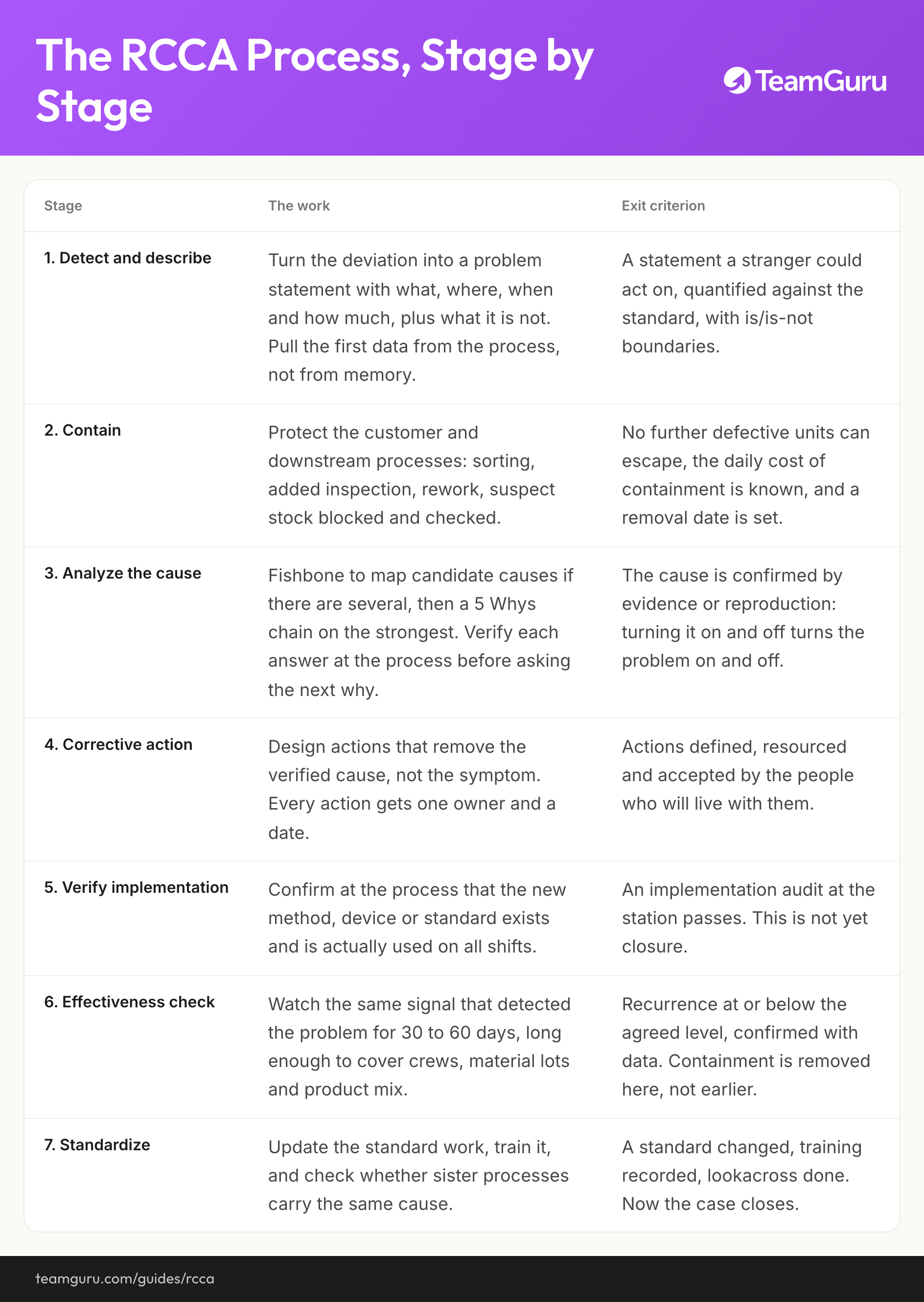
À emporter
Le diagramme de ce guide en image, libre d'usage dans vos formations internes et vos ateliers.
Télécharger le PNGQuestions fréquentes
Que veut dire RCCA ?
RCCA, 8D, QRQC, CAPA : quelles différences ?
Quelle différence entre une correction et une action corrective ?
Combien de temps dure un dossier RCCA ?
Qu'est-ce qui fait preuve pour une cause racine ?
Quand peut-on clore un dossier RCCA ?
Comment TeamGuru le met en pratique