Guide de mise en œuvre
Gemba Walk.
Le Gemba Walk, c'est un manager qui va là où le travail se fait pour le comprendre en regardant et en questionnant. Il observe le processus, jamais la personne, et son rôle y est de poser les questions, pas d'apporter les réponses : régler un problème sur place paraît utile et apprend surtout à l'équipe que réfléchir est l'affaire du chef. Aller voir, demander pourquoi, respecter les gens, dans cet ordre.
Ce qu'est un Gemba Walk
Gemba est le mot japonais pour le lieu réel : dans l'industrie, l'endroit où la valeur se crée. Un Gemba Walk, c'est un manager qui s'y rend, régulièrement et avec une intention, pour comprendre comment le travail se déroule vraiment, en l'observant et en posant des questions. Pas ce que dit l'ERP, pas ce que décrit le mode opératoire, mais ce que fait l'opérateur à 9h40 un mardi quand l'imprimante d'étiquettes se bloque.
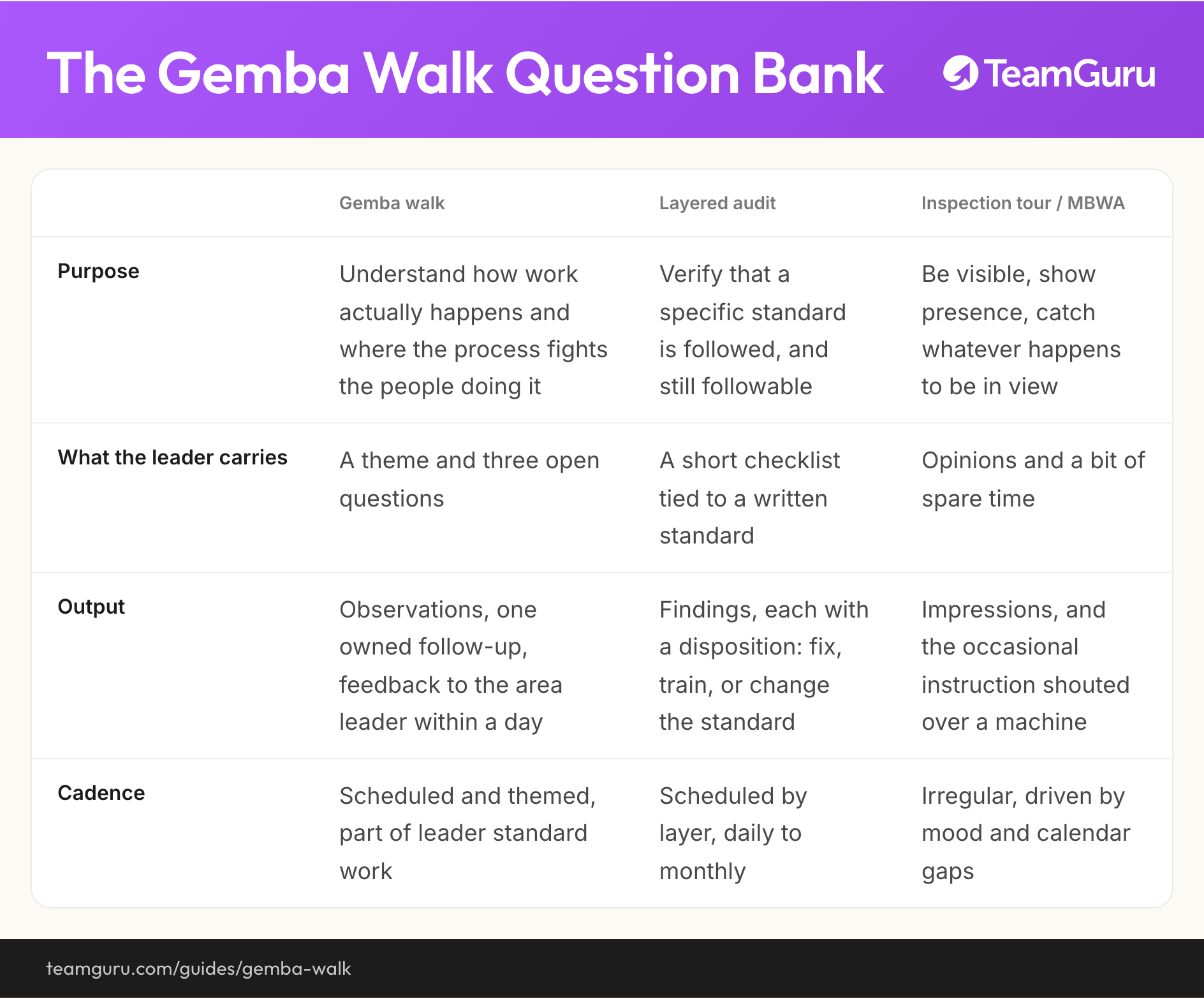
La définition paraît évidente, et c'est justement pour cela que la pratique se confond si souvent avec des activités qui, de loin, lui ressemblent. Un tour de terrain n'est pas un audit : l'audit vérifie un standard précis avec une check-list et produit des écarts. Ce n'est pas non plus une tournée d'inspection ni du management baladeur : la présence sans méthode donne des impressions, pas de la compréhension. Dans les trois cas un manager traverse l'atelier. Ce qui change, c'est ce qu'il emporte, ce qui en ressort, et ce que les équipes visitées apprennent à attendre.
| Gemba Walk | Audit LPA | Tournée d'inspection / MBWA | |
|---|---|---|---|
| Objectif | Comprendre comment le travail se fait vraiment et où le processus contrarie ceux qui l'exécutent | Vérifier qu'un standard précis est respecté, et qu'il reste tenable | Être vu, montrer sa présence, réagir à ce qui passe sous les yeux |
| Ce que le manager emporte | Un thème et trois questions ouvertes | Une check-list courte, adossée à un standard écrit | Des convictions et un créneau libre |
| Ce qui en sort | Des observations, une action dont il est lui-même le pilote, un retour au responsable de secteur dans la journée | Des écarts, chacun avec sa suite : corriger, former, ou changer le standard | Des impressions, et parfois une consigne lancée par-dessus une machine |
| Fréquence | Programmé et thématique, inscrit dans le travail standardisé du leader | Programmé par niveau, du quotidien au mensuel | Irrégulier, au gré de l'humeur et des trous dans l'agenda |
Les deux premières colonnes relèvent, l'une et l'autre, d'un vrai travail de management. Le dégât vient du mélange : un tour de terrain qui vire à l'audit apprend aux équipes que les questions ouvertes sont des pièges, et un audit déguisé en visite amicale produit des écarts sur des critères que personne n'a acceptés. Décidez lequel des deux vous faites avant de quitter le bureau, et dites-le en arrivant. Cette page traite de la première colonne.
La place du Gemba Walk dans la feuille de route
Sur la feuille de route de déploiement TeamGuru, le Gemba Walk apparaît deux fois. Il commence dans la phase de diagnostic comme méthode centrale du diagnostic de l'état actuel : avant de choisir des objectifs d'amélioration, les managers parcourent le flux pour voir comment l'usine tourne vraiment, aux côtés de la VSM, qui transforme ce regard en image chiffrée. Ensuite, il ne repart plus. Une fois le management quotidien en place, le tour de terrain entre dans le travail standardisé du leader comme une routine programmée et vérifiable, et il y reste aussi longtemps que le manager occupe son poste.
- Vous êtes ici Diagnostic de l'état actuel
- En parallèle VSM
- Après Management quotidien
- Après Travail standardisé du leader
Quand le tour fait des dégâts
Aller sur le terrain n'est pas bon en soi. Chaque tour enseigne quelque chose à l'organisation sur ses managers, et il l'enseigne vite : une visite maladroite peut ruiner des mois de tableaux honnêtes. Un tour mal mené fait plus de dégâts que pas de tour du tout dès qu'il ressemble à l'un de ceux-ci :
- La visite à verdict. Le manager traverse le secteur, tranche sur ce qu'un instantané semble montrer, et repart. Le secteur apprend à soigner les apparences, et le tour suivant voit encore moins la réalité.
- La visite en délégation. Six managers, un porte-bloc chacun, zéro écoute. Personne ne parle franchement à une délégation. Au-delà de deux ou trois personnes, ce n'est plus un tour de terrain, c'est une visite officielle.
- La liste de tâches sous-traitée. Le tour se termine par une liste d'actions pour le secteur, écrite sans le secteur, à partir d'une heure de contexte. Ceux qui vivent avec le processus reçoivent des devoirs de quelqu'un qui est passé.
- Ne venir que quand ça va mal. Si l'encadrement n'apparaît au bord de la ligne qu'après un mauvais mois, la présence devient elle-même un signal de menace, et chaque question est reçue comme une accusation.
Le point commun : tous les quatre étudient la personne au lieu du processus, ou imposent au secteur des conclusions qu'il n'a pas contribué à tirer. Si l'on ne sait pas encore faire un tour sans ces réflexes, mieux vaut corriger la méthode du visiteur que multiplier les visites.
Comment mener le tour
Un tour de terrain demande un thème, une structure et de la discipline sur le temps. Le thème réduit le champ, parce que chercher tout revient à ne rien voir. Un bon thème ne regarde qu'une chose à la fois : un gaspillage parmi les 7 gaspillages, en suivant les stocks ou les attentes pendant tout le tour ; un standard, en comparant le travail réel à la fiche de travail standardisé sur deux ou trois postes ; ou un flux, en suivant un seul OF ou une seule pièce de bout en bout et en notant chaque attente et chaque transfert.
La fiche de déroulé du tour
La fiche ci-dessous, c'est toute la méthode sur une page. Imprimez-la, pliez-la, emportez-la.
| Moment | Ce qu'il faut faire |
|---|---|
| Avant, 10 minutes | Choisissez le thème et un itinéraire de deux à quatre arrêts. Lisez d'abord le tableau du secteur : les chiffres de la veille, les escalades ouvertes, les problèmes en cours, pour que vos questions partent de là où l'équipe en est déjà. Prévenez le responsable de secteur de votre passage et du thème retenu. |
| Pendant, 30 à 45 minutes | À chaque arrêt, observez un cycle complet avant de dire quoi que ce soit. Posez ensuite trois questions de la banque, écoutez, et notez ce que vous avez vu et ce que vous avez entendu. Notez aussi les suites à donner, mais n'attribuez aucune tâche à personne sur place. |
| Après, dans la journée | Choisissez une action dont vous serez vous-même le pilote, et faites-la. Donnez un retour au responsable de secteur dans la journée : ce que vous avez vu, ce que vous avez appris, ce que vous allez faire. Pas de verdict au passage, pas de liste de tâches surprise par mail. |
Le plus difficile reste de ne pas bouger. L'instinct, en tour de terrain, pousse à avancer : marcher donne le sentiment d'être utile, rester planté met mal à l'aise. Taiichi Ohno faisait tenir ses élèves dans un cercle tracé à la craie sur le sol jusqu'à ce qu'ils sachent décrire ce qui se passait autour d'eux. Ni la craie ni les heures ne sont indispensables, le principe si : un coup d'œil donne un instantané, et un instantané a presque toujours l'air correct. Seul un cycle complet, et idéalement deux ou trois, révèle la variation : le geste qui n'est jamais tout à fait le même, la troisième tentative pour emmancher un raccord, les quelques pas pour aller chercher ce qui devrait être à portée de main. Sur 30 minutes, trois arrêts bien observés valent mieux que dix postes traversés.
Questionner sans juger
La banque de questions ci-dessous est classée par intention. Retenez-en trois par tour, accordées à votre thème, et laissez les réponses prendre le temps : trois questions vraiment écoutées apprennent plus que dix posées en regardant son téléphone. Vous ne collectez pas des réponses à noter. Vous apprenez à quoi ressemble le processus vu de l'intérieur.
| Intention | Questions au choix |
|---|---|
| Comprendre le travail |
|
| Les standards |
|
| Les problèmes |
|
| L'amélioration |
|
La façon dont une question est reçue relève de celui qui la pose, pas de celui qui y répond. Les mêmes mots passent pour de la curiosité ou pour un interrogatoire selon le ton, et l'écart hiérarchique amplifie tout ce qu'un manager dit au bord de la ligne. Deux règles couvrent l'essentiel. D'abord, interrogez le processus, jamais la personne : ce qui ralentit cette étape, et non pourquoi vous êtes lent. Ensuite, quand quelqu'un vous montre un problème, remerciez-le, visiblement, à chaque fois. Un problème qu'on vous montre est un acte de confiance, et une seule mauvaise réaction à une mauvaise nouvelle coûte un an de réponses sincères.
Fréquence par niveau
La fréquence suit le niveau : plus on est proche du terrain, plus le tour est court et fréquent. Le schéma ci-dessous convient à une usine de taille moyenne ; ajustez les durées, gardez les proportions.
| Niveau | Fréquence | Durée | Objet habituel |
|---|---|---|---|
| Chef d'équipe | Quotidien | 10 à 15 minutes | Son propre secteur : le tableau, un standard observé, les écarts de la veille |
| Responsable de secteur ou de flux | Hebdomadaire | 30 à 45 minutes | Un thème sur tout le secteur, en rotation : un gaspillage, un standard, un flux |
| Directeur de site | Hebdomadaire | 45 à 60 minutes | Un tour thématique sur un secteur, cycles complets observés, plus les tableaux d'AIC |
| Direction générale et visiteurs du groupe | Mensuel | 60 à 90 minutes | Un vrai tour avec le directeur de site : un flux suivi de bout en bout, pas une visite de couloir |
Ce qui fait survivre tout cela à un mauvais trimestre, c'est de l'inscrire dans le travail standardisé du leader : le tour devient une routine programmée sur la fiche du manager, sa réalisation est visible, et un tour sauté est un écart dont on parle comme de n'importe quel standard non tenu. Les tours qui ne vivent que de bonnes intentions meurent dès la première semaine chargée.
Ce qui fait échouer la pratique
Les programmes de Gemba Walk s'arrêtent rarement avec fracas. Ils s'éteignent, de quatre façons prévisibles, et chacune a une contre-mesure qui tient mieux comme règle permanente que comme rappel.
Le tour saute en premier
Sous pression, c'est la ligne la plus facile à supprimer dans l'agenda, et tout le monde la voit disparaître. Annuler les tours en période de crise apprend à l'usine qu'aller voir est une activité de beau temps, exactement l'inverse de ce qu'il faudrait : c'est en crise que la réalité compte le plus. Protégez le créneau comme une visite client et, s'il faut vraiment le déplacer, marchez moins longtemps plutôt que pas du tout.
Des notes qui ne mènent nulle part
Les observations s'accumulent dans un carnet que personne, pas même son auteur, ne rouvre. Ceux qui ont répondu aux questions n'ont jamais de retour, en concluent que le tour était du théâtre, et se mettent à donner des réponses de théâtre. La contre-mesure est courte et stricte : une action par tour, portée par le manager lui-même, close et restituée, et toutes les autres suites confiées à un circuit avec un pilote.
Régler le problème sur place
Le plus gradé voit un problème, connaît une réponse, et la donne. Cela ressemble à du leadership et cela marche exactement une fois. L'équipe apprend que réfléchir est l'affaire du chef, attend la visite suivante, et une solution bâtie sur dix minutes de contexte crée en général le problème d'après. Demandez ce que l'équipe essaierait, puis accompagnez ensuite par le responsable de secteur. Seule exception : la sécurité. Une situation dangereuse arrête le tour et se traite tout de suite.
L'itinéraire trop bien rodé
Même parcours, même jour, même heure, toutes les semaines. En un mois l'itinéraire est préparé : le secteur suivant est rangé pendant que vous vous garez. Variez le parcours et l'horaire, suivez une pièce plutôt qu'un couloir, et méfiez-vous d'un poste impeccable. Un terrain qui paraît parfait cache ses problèmes quelque part.
La suite
Un tour de terrain fournit la matière première de trois systèmes, et il vaut la peine de dire clairement quelle observation va où. Ce que vous avez appris du fonctionnement réel de l'usine alimente le diagnostic de l'état actuel et les priorités qui sortent de la phase de diagnostic. Les idées d'amélioration remontées par les opérateurs entrent dans le circuit Kaizen au nom de celui qui les a proposées, et non dans votre carnet. Les écarts au standard deviennent soit de la formation, soit une modification du standard via le travail standardisé, et les problèmes récurrents méritent de vrais 5 pourquoi menés au poste, plutôt qu'un diagnostic de couloir.
C'est sur la tenue des comptes que ces programmes fuient discrètement : les suites promises au bord de la ligne et oubliées au bureau. C'est la partie que TeamGuru rend opérationnelle : les constats du tour deviennent des actions avec un pilote et une échéance dans la gestion des projets et des actions, et les tours thématiques récurrents tournent comme des check-lists et audits programmés, pour que la réalisation, les constats et les photos vivent au même endroit et que la boucle de retour vers le secteur se referme visiblement, et non sur parole.
Sur la feuille de route, ce que les tours font remonter pendant le diagnostic devient la base de référence du management quotidien : les tableaux et les AIC qui transforment le fait de voir les problèmes en une gestion quotidienne. Une fois ce système en marche, le tour change de nature : de mission de diagnostic, il devient du travail de management ordinaire, et c'est là qu'il passe le reste de sa vie.
À emporter
Le diagramme de ce guide en image, libre d'usage dans vos formations internes et vos ateliers.
Télécharger le PNGQuestions fréquentes
Que signifie Gemba ?
Quelle différence entre un Gemba Walk et un audit ?
Combien de temps doit durer un Gemba Walk, et à quelle fréquence ?
Faut-il annoncer un Gemba Walk ?
Que faire des observations rapportées d'un tour ?
Peut-on faire un Gemba Walk dans les services support ?
Comment TeamGuru le met en pratique