Guide de mise en œuvre
Audits LPA.
Les audits LPA (Layered Process Audits) sont des vérifications courtes et fréquentes : le travail au poste correspond-il encore au standard ? Chaque niveau hiérarchique les mène, le chef d'équipe tous les jours, le responsable de secteur toutes les semaines, la direction du site tous les mois. Ce qu'ils produisent, ce sont des écarts, pas un score. L'audit mesure l'honnêteté du système, et chaque écart trouvé est du conseil gratuit ; un programme qui fête 98 % de conformité a en général cessé de poser de vraies questions.
Ce qu'est un audit LPA
Un audit LPA est une vérification courte et programmée : le travail qui se fait à un poste correspond-il encore à son standard ? Les réglages, la séquence, les contrôles, les conditions que prévoit la fiche standard. « Layered », étagé, veut dire que chaque niveau d'encadrement passe les mêmes standards au même crible, chacun à son rythme : le chef d'équipe tous les jours, le responsable de secteur toutes les semaines, la direction du site tous les mois. Un audit tient en une poignée de questions auxquelles on répond en regardant le processus, pas en relisant des documents dans un bureau.
La méthode vient de la filière automobile, où l'AIAG l'a formalisée dans le référentiel CQI-8 ; les usines du groupe Stellantis connaissent la même pratique sous le nom de VRS, et on rencontre aussi « audit de process étagé » ou « audit par couches ». Elle existe parce que les standards se dégradent en silence. Un outil est remplacé, un réglage glisse, un contrôle saute un vendredi chargé, et en une semaine le contournement est devenu un savoir qui se transmet oralement. L'audit système annuel repère cette dérive des mois plus tard, quand elle a déjà coûté quelque chose. L'audit LPA la repère en quelques jours, quand la correction est encore bon marché et la piste encore chaude.
Ce qui compte en sortie, c'est l'écart. Chaque écart est un constat précis et daté de l'endroit où la réalité s'est séparée du standard, trouvé par vos propres équipes avant de devenir du rebut, une réclamation client ou un accident. C'est du conseil gratuit, et c'est tout le retour sur investissement du programme. Le taux de conformité n'est qu'un sous-produit : un programme qui fête 98 % de conformité a généralement cessé de poser des questions auxquelles la réponse pourrait être non.
La place des audits LPA dans la feuille de route
L'audit LPA sert à faire tenir dans le temps ce qui a été mis en place, et c'est pour cela qu'il arrive tard. Sur la feuille de route de déploiement TeamGuru, il relève de la pratique Standardiser et déployer : il protège ce que les étapes précédentes ont construit, en vérifiant au poste que le travail standardisé est encore suivi et encore tenable, que le 5S rend toujours l'anomalie visible, et que les détrompeurs fonctionnent encore et n'ont pas été discrètement neutralisés. Sans étage d'audit, chacune de ces pratiques repose sur l'idée que personne ne sera jamais débordé, promu ou absent.
- Avant Travail standardisé et 5S
- Avant Obeya et revues de direction
- Vous êtes ici Standardiser et déployer
- En parallèle Matrice de compétences
Quand l'audit se retourne contre vous
Un programme d'audits peut dégrader une usine, et il le fait en général de l'une de ces trois façons. Ne lancez rien tant que les trois ne sont pas écartées :
- Il n'y a encore rien à auditer. L'audit compare la réalité à un standard ; si les standards n'existent pas, ou dorment dans un classeur introuvable depuis la ligne, écrivez et affichez d'abord le standard. Auditer des opinions produit des opinions.
- L'audit sert à noter les gens. Dès qu'un écart touche une prime ou remonte dans un entretien annuel, l'honnêteté meurt : les écarts se négocient à la baisse, les auditeurs adoucissent leurs questions, et les tableaux virent à un vert confortable. Le programme garde son coût et perd son information.
- Personne n'a la capacité de réagir. Si les écarts s'empilent sans suite, chaque audit apprend à l'organisation que regarder de près ne change rien. Cinq questions avec une boucle de réaction qui fonctionne valent mieux que quarante sans.
Le point commun : un programme LPA échoue socialement avant d'échouer techniquement. L'essentiel du travail de conception décrit plus bas sert à protéger l'honnêteté.
Construire le programme
Partez de ce qui se dégrade, pas de ce qui est facile à vérifier. Trois sources alimentent le premier vivier de questions :
- Les standards modifiés récemment. Un gain d'amélioration se perd surtout dans ses 90 premiers jours : tout ce qu'un chantier Kaizen ou un atelier vient de changer entre immédiatement dans la rotation d'audit.
- Les contrôles qualité critiques : ceux que votre AMDEC et votre plan de surveillance supposent faits à chaque équipe, comme la vérification du couple de serrage, le contrôle de première pièce et les détrompeurs.
- Les standards neufs : nouveau produit, nouveau moyen, nouvelles personnes. Partout où un standard est jeune, la dérive est probable et peu coûteuse à corriger.
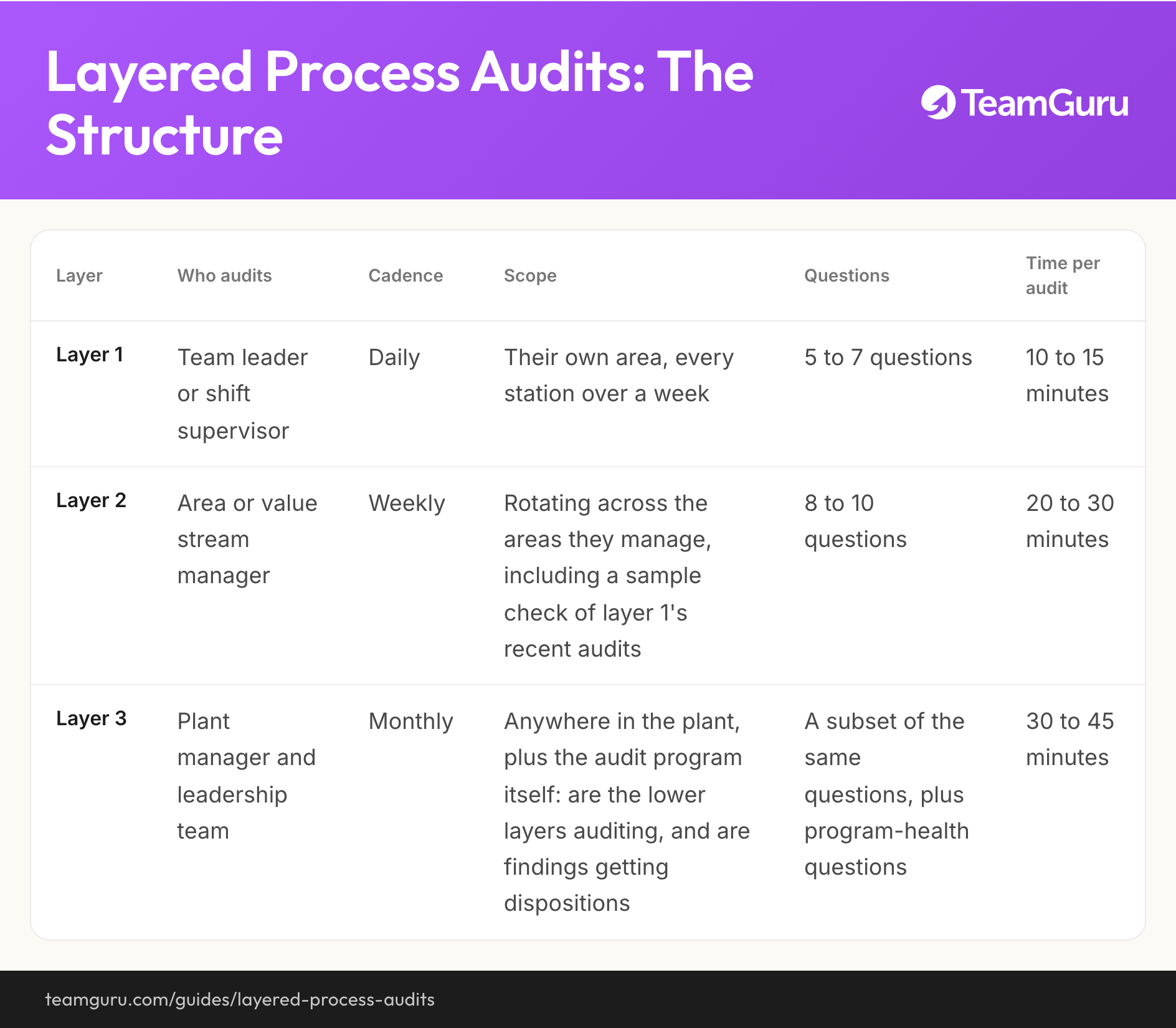
La deuxième source est l'endroit où le programme d'audit rejoint votre AMDEC : un contrôle qui n'existe que dans l'analyse et jamais dans une check-list n'est pas un contrôle. Structurez ensuite les niveaux. C'est là que se trouve le vrai levier de la méthode : les mêmes standards vus par des yeux neufs, avec une autorité croissante et une distance croissante vis-à-vis des habitudes quotidiennes du secteur.
| Niveau | Qui audite | Fréquence | Périmètre | Questions | Durée par audit |
|---|---|---|---|---|---|
| Niveau 1 | Chef d'équipe ou superviseur de production | Quotidien | Son propre secteur, tous les postes couverts sur une semaine | 5 à 7 questions | 10 à 15 minutes |
| Niveau 2 | Responsable de secteur ou de flux | Hebdomadaire | En rotation sur les secteurs dont il a la charge, avec un contrôle par sondage des derniers audits de niveau 1 | 8 à 10 questions | 20 à 30 minutes |
| Niveau 3 | Directeur de site et équipe de direction | Mensuel | N'importe où dans l'usine, plus le programme lui-même : les niveaux inférieurs auditent-ils, et les écarts reçoivent-ils une suite | Une partie des mêmes questions, plus des questions sur la santé du programme | 30 à 45 minutes |
Inscrivez les audits de niveaux 1 et 2 sur les fiches de routines des managers, dans le cadre du travail standardisé du leader, pour que l'audit ait un créneau protégé au lieu de se battre avec le bruit du quotidien. Gardez ensuite le vivier de questions vivant : renouvelez environ un tiers des questions chaque mois, et retirez toute question qui n'a produit aucun écart depuis trois mois. Une question toujours verte est soit un problème résolu, soit une question mal posée. Dans les deux cas, la minute qu'elle coûte revient à une autre question.
Écrire des questions qui trouvent
La rédaction des questions décide si le programme trouve quoi que ce soit. Quatre règles couvrent l'essentiel ; une bonne question doit :
- Trouver sa réponse en une minute environ par simple observation : l'auditeur regarde, compte ou observe un cycle. Tout ce qui demande une investigation est un sujet à traiter, pas une question d'audit.
- Se vérifier contre un standard écrit : la bonne réponse est sur une fiche standard, un graphique, une étiquette ou une photo de l'état attendu, jamais dans le jugement de l'auditeur.
- Être précise : la question nomme le poste, le paramètre et le document, pour que deux auditeurs différents arrivent à la même réponse le même jour.
- Porter sa preuve en elle-même. Pas « le couple de serrage est-il maîtrisé ? », mais « la visseuse est-elle réglée à la valeur de la fiche standard ? », pour que la réponse soit vérifiée et non ressentie.
| Question faible | Pourquoi elle échoue | Meilleure question |
|---|---|---|
| Le 5S est-il tenu dans le secteur ? | Un avis en oui/non, sans preuve nommée. La réponse est toujours oui à partir de l'après-midi. | Prenez une silhouette du tableau d'outils du poste 2 : l'outil est-il en place, ou sorti et enregistré ? |
| Les opérateurs respectent-ils le travail standardisé ? | Inobservable sous cette forme, et cela audite la personne au lieu du processus. | Observez un cycle au poste 3 : la séquence suit-elle les 7 étapes de la fiche de travail standardisé ? |
| Les moyens de serrage sont-ils correctement entretenus ? | Personne ne peut vérifier « correctement » en une minute, donc personne n'essaie. | La visseuse du poste d'emmanchement est-elle réglée à la valeur indiquée sur la fiche standard ? |
| La documentation qualité est-elle à jour ? | Trop large. Cela invite à jeter un œil dans un classeur et à cocher. | Ouvrez l'enregistrement du contrôle de première pièce de l'équipe en cours : complet, signé, dans les tolérances ? |
Un audit type en six questions
Voici à quoi ressemble un audit de niveau 1 pour l'îlot d'assemblage du fabricant de composants de 450 personnes qui sert d'exemple dans tous ces guides : 456 pièces par jour, un takt de 118 secondes. Les questions sont données à titre d'illustration, et volontairement courtes. Observer un cycle complet coûte deux minutes à ce takt, et l'audit entier tient dans 15 minutes.
| # | Question | Ce qu'elle protège |
|---|---|---|
| 1 | Demandez à l'opérateur du poste 3 de vous montrer la fiche de travail standardisé du produit en cours. Est-ce bien l'indice affiché, et les 2 pièces d'en-cours standard qu'elle prévoit sont-elles réellement là ? | L'intégrité du travail standardisé : la fiche est à jour et l'îlot tourne selon elle |
| 2 | Observez un cycle complet au poste 3. Le travail suit-il les 7 étapes de la fiche, dans l'ordre ? | La séquence telle qu'elle est écrite, observée et non affirmée |
| 3 | La visseuse du poste d'emmanchement est-elle réglée à la valeur de la fiche standard, et le compteur de vissage indique-t-il le dernier cycle complet ? | Un contrôle qualité critique et le détrompeur (Poka-Yoke) qui le sécurise |
| 4 | Ouvrez l'enregistrement du contrôle de première pièce de l'équipe en cours. Est-il complet, signé et dans les tolérances ? | Le contrôle du plan de surveillance que l'AMDEC suppose réalisé |
| 5 | Prenez deux silhouettes du tableau d'outils du poste 2. Chaque outil est-il en place, ou sorti et enregistré sur le tableau ? | Le 5S comme détecteur d'anomalie, et non comme rangement |
| 6 | Demandez à l'opérateur : qu'est-ce qui a changé à ce poste depuis un mois, et où est le standard à jour correspondant ? | Si les améliorations récentes sont bien passées dans les standards et la formation |
Mener un audit
Allez au poste et dites clairement ce que vous faites. Un audit LPA n'a pas besoin d'être une inspection surprise : vous auditez le processus, vous ne piégez pas la personne, et un standard qui ne tient que lorsque personne ne regarde est de toute façon un écart. Observez avant de questionner. Regardez le cycle, vérifiez les réglages, comptez les pièces, et seulement ensuite engagez la conversation.
Demandez qu'on vous montre, pas qu'on vous raconte. « Montrez-moi comment vous validez le couple de serrage » produit une preuve ; « est-ce que vous validez le couple ? » produit une réassurance. Et quand quelque chose s'écarte, écrivez l'écart sans mettre personne en cause : un standard non respecté est une donnée. Soit le standard est faux ou intenable, soit la formation n'a pas tenu, soit la situation a dérivé. Trois problèmes de système, trois corrections différentes, et aucun n'est un verdict sur l'opérateur. La question que porte l'auditeur, c'est qu'est-ce qui a permis cela, jamais qui a fait cela.
Deux comportements décident de la réputation du programme dans l'atelier. D'abord, ne corrigez jamais en silence pour passer à autre chose : remettre en état sans enregistrer l'écart efface précisément le signal que le programme existe pour recueillir. Ensuite, remerciez ceux qui vous montrent quelque chose. L'opérateur qui vous dit « ce comparateur coince, on tape dessus deux fois » vient de vous offrir un écart qu'aucune check-list n'aurait fait remonter. Sanctionnez cette franchise une fois, et le programme devient aveugle pour un an.
De l'écart à l'action
Chaque écart reçoit une suite dans la semaine, et il n'y en a que trois :
- Corriger. Le standard est bon et c'est la situation qui a dérivé : un outil manquant, un réglage faux, une étiquette usée. Remettez en état, vérifiez, et notez si la même correction revient sans arrêt.
- Former. Le standard est bon et tenable, mais l'exécution a dérivé. Reformez au poste, pas en salle, et posez la question plus difficile : pourquoi cette dérive est-elle restée invisible jusqu'à ce qu'un audit la trouve ?
- Changer le standard. Le standard est faux, périmé ou intenable, et l'opérateur compensait. Corrigez le document, pas la personne. Dans un programme sain, cette suite représente une part importante des écarts.
Écarts et suites sont suivis en tendance tous les mois, en revue de direction : écarts ouverts et écarts clos dans la semaine, écarts qui reviennent sur une même question, taux de réalisation des audits par niveau. Lisez le pourcentage de conformité comme un signal d'honnêteté, pas comme une cible. Un programme sain se tient confortablement en dessous de 100 % et produit un flux régulier de petits écarts refermés ; voir le nombre d'écarts par audit tomber vers zéro alors que les questions n'ont pas bougé est une alerte, pas une victoire.
Ce qui fait échouer la pratique
Ce à quoi ressemble un mauvais programme
- Des check-lists remplies depuis le bureau, de mémoire, en fin de semaine
- Un marathon de 40 questions qui prend une heure : il glisse, puis s'arrête sans bruit
- Des écarts consignés dans un tableur où rien n'a ni pilote ni suite
- 98 % de conformité célébrés en revue mensuelle pendant que le rebut ne bouge pas
- Les mêmes questions pendant un an, que tout le monde connaît, réponses comprises
- Le service qualité audite seul pendant que l'encadrement de la ligne signe le formulaire
Ce à quoi ressemble un bon programme
- 5 à 7 questions, 10 à 15 minutes, au poste, dans un créneau protégé
- Les trois niveaux tenus par l'encadrement de la ligne, jusqu'au directeur de site
- Chaque écart avec sa suite dans la semaine : corriger, former, ou changer le standard
- Les questions tournent tous les mois ; celles qui restent vertes sont retirées
- Les scores lus comme des tendances et des signaux d'honnêteté, les écarts comme le vrai produit
- Résultats et écarts ouverts visibles dans le secteur, à côté des tableaux d'équipe
La suite
Un programme qui tourne produit deux flux de valeur. Le premier, c'est la boucle décrite plus haut, écart après écart. Le second, c'est ce qui se répète : une question qui produit des écarts coup sur coup signale un standard sous tension permanente, un standard de changement de série qui ne survit jamais à l'équipe de nuit, un contrôle que tous les niveaux trouvent sauté. Ces répétitions sont des sujets d'amélioration avec les preuves déjà attachées, et elles alimentent le circuit Kaizen mieux que n'importe quelle boîte à idées.
Ce qui tue les programmes LPA sur papier, ce n'est presque jamais l'audit lui-même : c'est la tenue des comptes. Trois niveaux, des jeux de questions en rotation, des dizaines d'écarts par mois, chacun avec un pilote, une suite et une échéance. C'est là que TeamGuru tient la pratique : les check-lists et audits programment chaque niveau, font passer les questions sur téléphone ou tablette au bord de la ligne avec photo à l'appui, et confient chaque écart à la gestion des actions sous forme d'action avec un pilote et une échéance, pour que la revue mensuelle des tendances lise des données vivantes plutôt qu'un tableur recompilé.
Sur la feuille de route, les audits LPA ne s'arrêtent pas : ils durent aussi longtemps que les standards qu'ils protègent. Ils sont le garde-fou de Standardiser et déployer, et ils avancent de pair avec la matrice de compétences, qui développe précisément la capacité que les audits ne cessent de vérifier : des opérateurs capables de tenir le processus au standard, et des managers capables de voir quand il dérive.
À emporter
Le diagramme de ce guide en image, libre d'usage dans vos formations internes et vos ateliers.
Télécharger le PNGQuestions fréquentes
Quelle différence entre un audit LPA et un audit système qualité ?
Combien de questions dans un audit LPA ?
Combien de temps doit durer un audit ?
Qui audite quoi dans un programme LPA ?
Que deviennent les écarts relevés en audit ?
Comment éviter les audits remplis au bureau ?
Comment TeamGuru le met en pratique