Umsetzungsleitfaden
Yokoten.
Yokoten ist die Lean-Praxis, eine bewährte Verbesserung oder Gegenmaßnahme seitwärts auszubreiten: von der Linie oder dem Werk, das sie entwickelt hat, an jeden Ort mit demselben Problem. Die Arbeitsregel lautet: Standard übernehmen, Methode anpassen, Ergebnis halten. Kopieren ignoriert die örtlichen Bedingungen und erzeugt stille Ablehnung, Neuerfinden verschenkt das Gelernte. Das empfangende Team muss verstehen, warum die Praxis wirkt, dann lokal entscheiden, wie es sie betreibt, und dasselbe Ergebnis nachweisen.
Was Yokoten bedeutet
Yokoten ist die horizontale Ausbreitung bewährter Praxis. Eine Linie, eine Schicht oder ein Werk entwickelt etwas, das nachweislich funktioniert: eine schnellere Rüstmethode, eine sauberere Eskalationsroutine, eine Vorrichtung, die einen Fehler verhindert. Yokoten ist die Disziplin, dieses Gelernte seitwärts an jeden Ort mit demselben Problem zu tragen. Zwei Ströme gehören dazu: Verbesserungen, bei denen sich ein besserer Weg ausbreitet, und Gegenmaßnahmen, bei denen eine an einer Linie verifizierte Ursache alle Schwesterlinien veranlasst, sich selbst zu prüfen.
Yokoten scheitert in beide Richtungen. Verordnetes Kopieren schreibt die Lösung der Quelle überall vor, ignoriert die örtlichen Bedingungen und erzeugt die stille Ablehnung, die jedes Werk kennt: Der neue Standard hängt aus, ist unterschrieben und wird umgangen. Das Gegenteil ist die Neuerfindung an jedem Standort: Jeder löst dasselbe Problem von vorn, zum vollen Preis, und die Organisation bezahlt dasselbe Lernen fünfmal. Die Arbeitsregel, die beides vermeidet: Standard übernehmen, Methode anpassen, Ergebnis halten. Der empfangende Standort muss verstehen, warum die Praxis wirkt, bevor er entscheidet, wie er sie lokal betreibt, und über das Ergebnis, auf das er sich verpflichtet, wird nicht verhandelt.
Der Träger von Yokoten ist standardisierte Arbeit. Eine Praxis, die nur in jemandes Kopf oder nur in einer Präsentation existiert, kann nicht reisen. Eine Praxis, die als lebender Standard festgehalten ist, mit ihren Bedingungen und ihrem gemessenen Ergebnis, lässt sich anderswo ansehen, lehren, erproben und verifizieren.
Wo Yokoten in der Transformations-Roadmap steht
Auf der TeamGuru-Einführungs-Roadmap gehört Yokoten zur Praxis Standardisieren & Skalieren in der Stufe Skalieren, und es ist der Ertrag von allem, was vorher standardisiert wurde. Aus Kaizen kommen die verifizierten Verbesserungen, die eine Übertragung wert sind, standardisierte Arbeit macht sie übertragbar, und der Besprechungsrhythmus aus der Praxis Obeya und Managementbewertungen gibt Übertragungen einen Ort, an dem sie ausgewählt, verfolgt und verifiziert werden. Ohne dieses Fundament verkommt Yokoten zu einem Best-Practice-Newsletter.
- Davor Kaizen
- Davor Obeya & Managementbewertungen
- Sie sind hier Standardisieren & Skalieren
- Parallel dazu Qualifikationsmatrix
Wann Sie nicht ausbreiten sollten
Der häufigste Yokoten-Fehler passiert, bevor irgendeine Übertragung beginnt: eine Praxis auszubreiten, die an ihrer Quelle noch nicht stabil ist. Eine Praxis muss den Kontakt mit dem normalen Alltag überstehen, mit Abwesenheiten, Modellwechseln, einer schlechten Woche, bevor sich ihr Export lohnt. Ein Standort, der eine Praxis 90 Tage lang gut betreibt, schlägt die konzernweite Einführung eines Prototyps. Diese 90 Tage liefern genau die zwei Dinge, die ein Empfänger am dringendsten braucht: den Nachweis, dass das Ergebnis hält, und das Wissen über die Bedingungen, von denen es abhängt. Wer einen Prototyp flächendeckend einführt, verbreitet die Fehler zusammen mit der Funktion. Jeder empfangende Standort behebt sie einzeln und zum vollen Preis, während das Vertrauen in die ganze Idee versickert. Verzichten Sie auf die Übertragung, wenn:
- Die Praxis ist an der Quelle jünger als rund 90 Tage. Sie lebt womöglich noch von der Aufmerksamkeit ihrer Erfinder und steht noch nicht auf ihrem Standard.
- Die Quelle kann die Bedingungen nicht benennen, von denen das Ergebnis abhängt. Ohne Bedingungen kann der empfangende Standort nicht beurteilen, was zutrifft und was nicht.
- Das Ergebnis wurde behauptet, nicht gemessen. Eine Praxis ohne Vorher-Nachher-Daten verbreitet eine Geschichte, keine Methode.
- Kein empfangender Standort hat das Problem überhaupt. Ausbreiten um der Einheitlichkeit willen erzeugt Regalware und Widerstand zu gleichen Teilen.
So läuft eine Übertragung
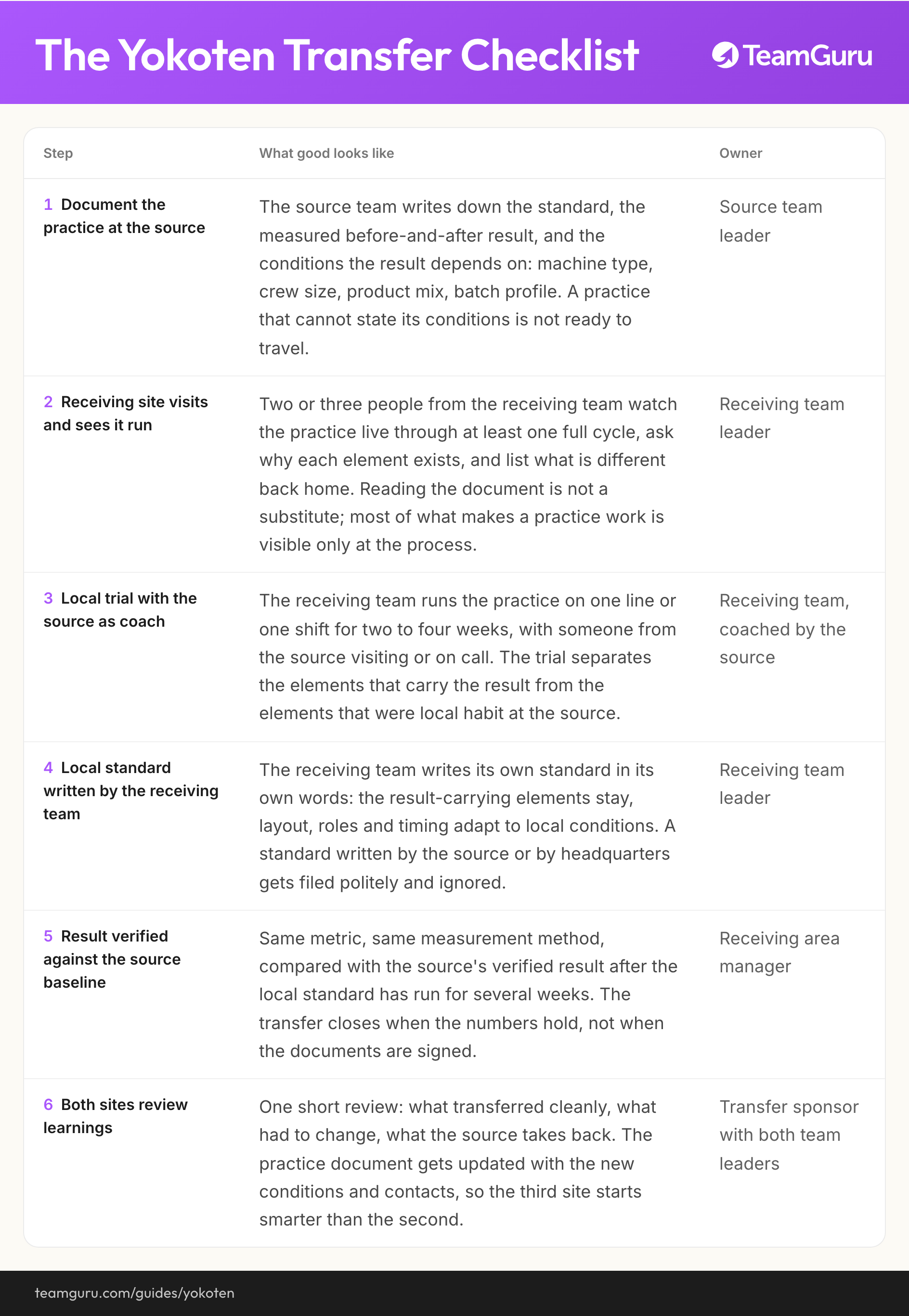
Eine Yokoten-Übertragung ist ein kleines Projekt mit sechs Schritten und benannten Verantwortlichen, keine E-Mail mit Anhang. Damit die Schritte konkret werden, verfolgen Sie eine beispielhafte Übertragung bei dem Komponentenhersteller mit 450 Beschäftigten, der auf dieser Website als durchgängiges Beispiel dient: Zerspanungslinie 2 hat ihre Rüstzeit mit einem SMED-Projekt von 47 auf 18 Minuten gesenkt und hält den neuen Standard seit vier Monaten. Eine Schwesterlinie in einem zweiten Werk fährt ähnliche Maschinen mit kleinerer Besetzung und schwererem Produktmix, und ihre Rüstvorgänge dauern weiterhin rund 45 Minuten.
| Schritt | So sieht es gut aus | Verantwortung |
|---|---|---|
| Praxis an der Quelle dokumentieren | Das Quellteam schreibt den Standard auf, das gemessene Ergebnis vorher und nachher sowie die Bedingungen, von denen dieses Ergebnis abhängt: Maschinentyp, Teamgröße, Produktmix, Losgrößenprofil. Eine Praxis, die ihre Bedingungen nicht benennen kann, ist nicht reisefertig. | Teamleitung der Quelle |
| Empfangender Standort besucht und sieht die Praxis laufen | Zwei oder drei Personen aus dem empfangenden Team beobachten die Praxis live über mindestens einen vollständigen Zyklus, fragen bei jedem Element nach dem Warum und notieren, was zu Hause anders ist. Das Dokument zu lesen ersetzt das nicht: Das meiste, was eine Praxis wirksam macht, ist nur am Prozess sichtbar. | Teamleitung des empfangenden Bereichs |
| Lokaler Versuch mit der Quelle als Coach | Das empfangende Team fährt die Praxis zwei bis vier Wochen auf einer Linie oder in einer Schicht, begleitet von jemandem aus dem Quellteam vor Ort oder auf Abruf. Der Versuch trennt die Elemente, die das Ergebnis tragen, von denen, die an der Quelle nur lokale Gewohnheit waren. | Empfangendes Team, gecoacht von der Quelle |
| Lokaler Standard, geschrieben vom empfangenden Team | Das empfangende Team schreibt seinen eigenen Standard in eigenen Worten: Die ergebnistragenden Elemente bleiben, Layout, Rollen und Zeitpunkte passen sich den örtlichen Bedingungen an. Ein Standard, den die Quelle oder die Zentrale schreibt, wird höflich abgeheftet und ignoriert. | Teamleitung des empfangenden Bereichs |
| Ergebnis gegen die Baseline der Quelle geprüft | Gleiche Kennzahl, gleiche Messmethode, verglichen mit dem verifizierten Ergebnis der Quelle, nachdem der lokale Standard einige Wochen gelaufen ist. Die Übertragung ist abgeschlossen, wenn die Zahlen halten, nicht wenn die Dokumente unterschrieben sind. | Bereichsleitung des empfangenden Werks |
| Beide Standorte werten die Erkenntnisse aus | Eine kurze Nachbesprechung: Was ließ sich sauber übertragen, was musste geändert werden, was nimmt die Quelle für sich mit. Das Praxisdokument wird um die neuen Bedingungen und Kontakte ergänzt, damit der dritte Standort klüger startet als der zweite. | Sponsor der Übertragung mit beiden Teamleitungen |
Zwei Regeln lassen diese Reihenfolge funktionieren. Erstens: Menschen reisen, Dokumente folgen. Die Praxis laufen zu sehen schlägt jede Lektüre, denn das Dokument hält fest, woran das Quellteam beim Schreiben gedacht hat, während der Besuch alles Übrige zeigt: wie der Rüstwagen bereitgestellt wird, was die Bedienperson ungefragt prüft, woher die Zeit tatsächlich kommt. Planen Sie die Reise ein; sie ist der billigste Teil der Übertragung und das Erste, was das Controlling streichen will.
Zweitens: Das empfangende Team verantwortet seine Einführung. Die Quelle coacht, der Sponsor räumt Hindernisse aus dem Weg, aber der lokale Versuch, der lokale Standard und das verifizierte Ergebnis gehören den Menschen, die mit der Praxis leben werden. Verantwortung ist keine Höflichkeit. Sie ist der Mechanismus, der aus einer fremden Lösung einen lokalen Standard macht, der die Nachtschicht, die Urlaubszeit und die nächste Reorganisation übersteht.
Kopieren gegen Yokoten
Die Rüstzeit-Übertragung zeigt die Aufteilung in der Praxis. Was übertragen wird: die Trennung von interner und externer Rüstarbeit, die Schnellspanner, die standardisierte Erstteilprüfung und das Ergebnisziel von unter 20 Minuten Rüstzeit. Was angepasst wird: Die externe Vorbereitung wird anders bereitgestellt, weil das empfangende Team aus zwei statt drei Personen besteht, und das Vorrichtungsregal steht auf der anderen Seite des Gangs. Was nie angepasst werden darf: Rüstminuten, gleich gemessen, vom letzten Gutteil bis zum ersten Gutteil, verglichen mit der Baseline der Quelle. Diese Dreiteilung, übertragen, anpassen, verifizieren, ist die ganze Methode in einer Tabelle:
| Element | Kopieren per Vorgabe | Yokoten |
|---|---|---|
| Der Standard und seine Logik | Wort für Wort vorgeschrieben, samt Details, die nur an der Quelle sinnvoll waren | Wird übertragen, zusammen mit der Begründung: Das empfangende Team lernt, warum jedes Element das Ergebnis trägt, bevor es irgendetwas entscheidet |
| Das Ergebnisziel | Wird selten genannt; Dokumente zu verteilen gilt als erledigt | Wird unverändert übertragen: Der Empfänger verpflichtet sich auf das verifizierte Ergebnis der Quelle, bevor er sonst etwas anpasst |
| Layout, Rollen, Zeitpunkte | Werden kopiert, auch wenn Linien, Besetzung und Schichtmodelle sich unterscheiden | Werden vom empfangenden Team bewusst angepasst, mit der Quelle als Coach |
| Verifizierung | Entfällt oder wird durch ein Häkchen „Einführung abgeschlossen“ ersetzt | Wird nie angepasst: gleiche Kennzahl, gleiche Messmethode, verglichen mit der Baseline der Quelle, Wochen nach dem Start |
Die Zeile zur Verifizierung ist die, die Organisationen zuerst wegverhandeln, und die, die alles andere ehrlich macht. Eine Übertragung, deren Ergebnis beim Empfänger anders gemessen wird, ist keine Übertragung. Sie besteht aus zwei zusammenhanglosen Projekten mit demselben Namen.
Yokoten für Gegenmaßnahmen
Der zweite Yokoten-Strom bewegt sich schneller und ist leichter zu begründen: Er breitet verifizierte Ursachen aus, nicht nur Verbesserungen. Wenn eine Linie eine Grundursache nachweist, etwa eine zu gering angezogene Verschraubung, zurückverfolgt auf eine fehlende Prüfung im Arbeitsstandard, dann prüft sich jede Schwesterlinie und jede ähnliche Produktfamilie innerhalb von Tagen gegen diese Ursache, nicht erst im nächsten Auditzyklus. Die Frage, die jede Linie beantwortet, ist kurz: Kann das hier passieren, und was ist der Beleg? Eine Meinung zählt nicht als Antwort; jemand sieht sich Prozess, Standard und Daten an.
Formale Problemlösungsmethoden haben das eingebaut. Disziplin D7 eines 8D-Reports, die Vorbeugung, ist eine Yokoten-Anweisung: FMEA und Produktionslenkungsplan aktualisieren, dann über ähnliche Teile, Linien und Werke hinweg nach demselben Fehlermodus suchen. Ein Fehler, der an einem Produkt gefunden und in derselben Woche über die ganze Familie geprüft wird, ist Yokoten in seiner günstigsten Form, denn die Kosten des Lernens hat bereits die Linie bezahlt, die den Fehler gefunden hat. Bei Ursachen, die längere Beobachtung verdienen, kann die Prüfung für ein Quartal in den Fragenkatalog der Layered Process Audits (LPA) des Werks wandern, damit mehr als ein Augenpaar den Quercheck bestätigt.
Die Geschwindigkeit trennt die beiden Ströme. Eine Praxisübertragung verdient die vollständige Sechs-Schritte-Checkliste und dauert Wochen. Yokoten für Gegenmaßnahmen wird in Tagen gemessen und braucht drei Schritte: Die verifizierte Ursache reist mit ihrem Beleg, jede Schwesterlinie beantwortet die Frage am Prozess, und die Antworten werden dort festgehalten, wo der ursprüngliche Problemfall sie sehen kann.
Yokoten systematisch machen
Eine Übertragung ist ein Projekt. Ein Yokoten-System braucht drei feste Bestandteile. Der erste ist eine gemeinsame Praxisbibliothek, die ihre Existenz rechtfertigt: Jeder Eintrag trägt den Standard, das gemessene Ergebnis, die Bedingungen, von denen es abhängt, und eine benannte Kontaktperson, die einen Besuch empfängt. Ein Eintrag, dem eines dieser vier Dinge fehlt, ist Ballast, und eine Bibliothek voller Ballast ist der Grund, warum die meisten Best-Practice-Portale ungeöffnet bleiben. Fünfzig Einträge, die diese Latte erfüllen, schlagen fünfhundert, die es nicht tun.
Der zweite Bestandteil ist der Nachschub. Kaizen endet ohnehin mit einem Schritt zum Standardisieren und Teilen; genau dort werden Kandidaten für die Bibliothek nominiert, zusammen mit abgeschlossenen Problemfällen, deren Gegenmaßnahmen einen Standard verändert haben. Niemand sollte daran denken müssen, die Bibliothek zu füttern. Die Verbesserungs- und Problemlösungssysteme tun es, während sie ihre eigenen Regelkreise schließen.
Der dritte Bestandteil ist ein Rhythmus. Quartalsweise Austauschrunden bringen die Standorte zusammen, um verifizierte Übertragungen zu zeigen und die nächsten auszuwählen, wobei die Besuche noch vor Ende des Termins geplant werden. Und die monatliche Managementbewertung (Management Review) stellt eine stehende Frage: Welche unserer verifizierten Verbesserungen hat ein zweiter Standort übernommen, und was hält den Rest auf? Die Frage kostet zwei Minuten und hält das System ehrlich, denn ein Quartal ohne Übertragungen ist ein Befund, kein Zufall.
Typische Fehlermuster
Yokoten scheitert in wiedererkennbaren Mustern, und fast alle entstehen dadurch, dass entweder der Besuch, die lokale Verantwortung oder die Verifizierung übersprungen wurde.
So sieht es schlecht aus
- Ein Konzernportal für Best Practices mit hunderten Einträgen, ohne Bedingungen, ohne Ansprechpartner, ohne dokumentierte Besuche
- Verordnetes Kopieren nach Konzerntermin, das binnen eines Monats leise in der Nachtschicht stirbt
- Erfolgstheater: Übertragungsergebnisse werden auf einer Statusfolie behauptet und nie an der empfangenden Linie gemessen
- Übertragungen ohne benannte Verantwortung auf der Empfängerseite, sodass die Einführung allen und niemandem gehört
- Standorte, die für den Export von Praktiken belohnt und für deren Anpassung still bestraft werden
So sieht es gut aus
- Jede Praxis reist mit ihren Bedingungen, ihrem gemessenen Ergebnis und einer benannten Kontaktperson, die Besuche empfängt
- Empfangende Teams sehen die Praxis laufen, bevor sie entscheiden, wie sie sie lokal betreiben
- Lokale Standards, geschrieben von den Menschen, die später daran gemessen und auditiert werden
- Dieselbe Kennzahl, gleich gemessen, geprüft gegen die Baseline der Quelle
- Beide Standorte werten die Erkenntnisse aus, und die Praxisbibliothek wird aktualisiert
Was danach kommt
Yokoten steht am Ende der Roadmap, weil es alles vervielfacht, was die früheren Stufen aufgebaut haben. Ein Werk, das standardisiert, verbessert und verifiziert, kann Gelerntes weitergeben; ein Werksverbund, der es weitergibt, lernt in einem Tempo, das kein einzelner Standort erreicht. Die stille Voraussetzung ist Vergleichbarkeit: Ausbreitung wird erst sichtbar, wenn die Standorte dieselben Dinge auf dieselbe Weise messen. Deshalb zählt ein gemeinsamer Satz von KPI-Definitionen für Yokoten mehr als jedes Portal. Definieren zwei Werke die Rüstzeit unterschiedlich, kann niemand sagen, ob die Übertragung funktioniert hat.
Die zweite Voraussetzung ist, dass Standards dort liegen, wo sie übernommen und nicht bloß weitergeleitet werden. Genau hier fügt sich TeamGuru in die Kette: Mit dem Dokumentenmanagement bleiben Praktiken versioniert und standortübergreifend sichtbar. Einen Standard zu übernehmen bedeutet dann, ein funktionierendes, aktuelles Dokument samt seinen Bedingungen und seiner Historie zu übernehmen, statt ein PDF zu erhalten, das schon am Tag des Versands veraltet war. Der empfangende Standort schreibt seinen lokalen Standard neben den der Quelle, und beide bleiben auffindbar, wenn der dritte Standort danach fragt.
In der Stufe Skalieren der Roadmap läuft Yokoten parallel zur Arbeit an der Qualifikationsmatrix, also am gezielten Aufbau von Kompetenz: Übertragungen laufen schneller, wenn der empfangende Standort bereits Menschen hat, die auf den zugrunde liegenden Standards qualifiziert sind, und jede abgeschlossene Übertragung schafft die nächste Generation von Coaches.
Zum Mitnehmen
Das Diagramm aus diesem Leitfaden als Bild, frei verwendbar in internen Schulungen und Workshops.
PNG herunterladenHäufig gestellte Fragen
Was bedeutet Yokoten?
Worin unterscheidet sich Yokoten vom Teilen von Best Practices?
Wer verantwortet eine Yokoten-Übertragung?
Wie prüfen Sie, ob eine Übertragung funktioniert hat?
Braucht Yokoten ein zentrales Team?
Woran erkennen Sie, was sich zu übertragen lohnt?
So setzt TeamGuru das um