Implementation Guide
Lean Daily Management.
Lean daily management is the plant's nervous system: visual boards that surface deviations within hours, a tiered meeting rhythm that answers them, escalation that moves the hard ones up before the day ends, and leader routines that keep the loop honest. Until deviations are seen and answered the same day, every optimization effort leaks away faster than it accumulates. This page shows how the four components work as one loop, and how to build it in 90 days.
What lean daily management is
A plant produces deviations all day: a machine slows, a defect slips through, an absence breaks the crewing plan, a supplier truck is late. None of these is unusual. What separates plants is how long a deviation lives before someone with the authority to fix it sees it. In most plants the answer is days: the miss surfaces in a weekly report, gets discussed in a monthly meeting, and by then the trail is cold. Lean daily management, also called shop floor management or a daily management system, cuts that answer to hours.
It is not one tool. It is four components wired into a single loop. Boards make deviations visible against a target. Tier meetings decide, within minutes, who acts on each one. Escalation carries anything a team cannot solve up to the level that can, the same day, with a promised response time. Leader standard work and structured problem solving close the loop: leaders verify the system is being used honestly, and repeat deviations get root-cause treatment instead of a third workaround. Remove any one component and the others degrade into ritual: boards without meetings become wallpaper, meetings without escalation become complaint sessions, escalation without response kills honesty.
This is the umbrella page: it explains how the parts fit and how to build the loop. Each part has its own deep guide, and the table below tells you, per component, when you actually have it rather than a poster of it.
The daily management loop
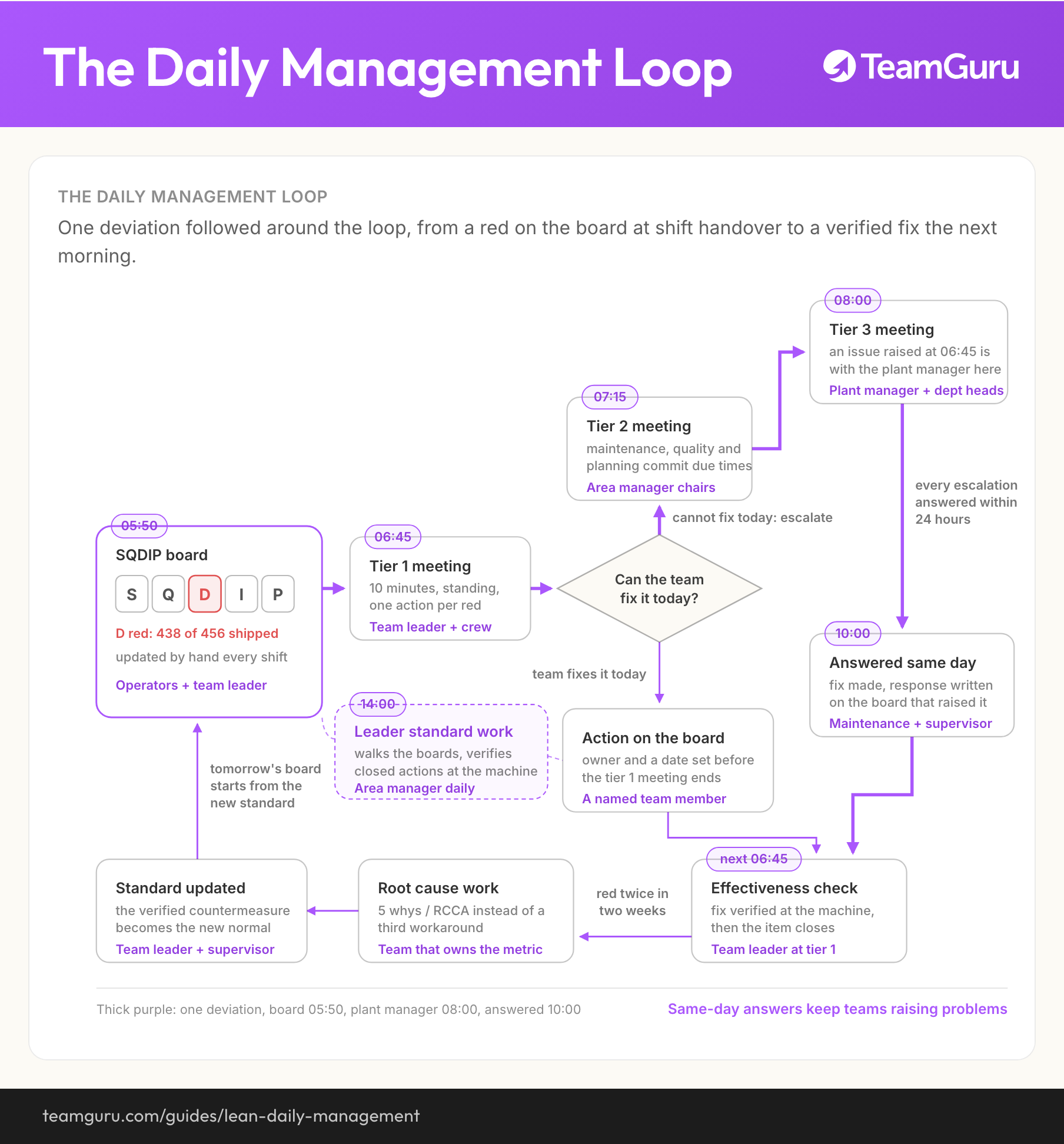
One deviation followed around the loop, from a red on the board at shift handover to a verified fix the next morning.
| Component | Deep guide | You have it when |
|---|---|---|
| Visual performance boards Make today's deviations visible within hours, not in the monthly report | SQDIP boards | An operator at the board can say in one sentence whether the line is winning or losing today, and every red has an action with a name and a date beside it. |
| Tier meeting cascade Decide who acts on each deviation, in minutes, at the right level | Tier meetings | Tiers 1, 2 and 3 run at fixed times every day, standing, in 15 minutes or less, and an issue raised at 06:45 can reach the plant manager by 08:00. |
| Leader standard work Keep the loop honest: check boards, coach meetings, verify closed actions | Leader standard work | Leaders' daily checks are scheduled, survive vacations, and a skipped round is visible to that leader's own manager. |
| Structured problem solving Kill repeat deviations at the root instead of working around them again | 5 whys and RCCA | A deviation that appears twice triggers a root-cause method with a verified countermeasure, not a bigger workaround. |
Where it sits in the transformation roadmap
On the TeamGuru deployment roadmap, daily management is the Daily Management practice and the heart of the Run Daily band. It starts once strategy deployment has named the few priorities the boards should reflect, runs in parallel with standard work and 5S, which give deviations a standard to deviate from, and it is the platform that leader standard work and structured problem solving are built on.
- Before Strategy Deployment
- You are here Daily Management
- In parallel Standard Work & 5S
- After Leader Standard Work
- After Structured Problem Solving
Why it comes before improvement
The instinct after strategy deployment is to launch improvement projects immediately: the priorities are named, so start improving. Resist it. Adding kaizen to an uncontrolled process is pushing water uphill, for three reasons.
- Without a daily baseline you cannot tell an improvement from a lucky week. A process that swings 15 percent day to day will absorb any kaizen result into its noise.
- Unattended processes drift. A gain that nobody checks daily erodes in weeks, and the plant runs improvement workshops to win back ground it already held. Daily management is the ratchet that holds each new level.
- Firefighting eats the same people who would improve. Until same-day response shrinks the firefighting load, the hours budgeted for improvement projects are fiction.
That is why the roadmap places daily management ahead of the kaizen practice and the whole Improve band. Stability is not the reward for improvement. It is the precondition. A plant that catches deviations the same day has, almost as a side effect, built the discipline that improvement work will later stand on.
How to build it in 90 days
Build the loop in one area first, then scale, and build it in the order the components depend on each other: visibility before meetings, meetings before escalation, escalation before leader routines. Choosing the handful of board metrics is its own decision; the manufacturing KPIs guide and the SQDIP guide cover it in depth. The sequence below assumes a mid-size plant and a CI lead or external coach at roughly half time.
| When | Focus | Who does what |
|---|---|---|
| Weeks 1 to 2 | Baseline and first board | Pick one pilot area with a supervisor who wants it, not the worst line in the plant. The supervisor and the CI lead choose 4 to 6 metrics the team can actually influence and record by hand at the end of each shift, usually one per SQDIP letter. Build the board on a whiteboard, not in IT. Record two baselines nobody will enjoy: how many deviations yesterday produced, and how long the oldest open issue has been open. |
| Weeks 3 to 4 | Tier 1 running daily | The team leader chairs a 10-minute tier 1 at the same time every day, standing at the board: safety first, then yesterday's misses, then today's plan, then one action per red. The area supervisor attends daily for two weeks to coach the team leader, then steps back. Expect the first week to be awkward and 20 minutes long; hold the time slot anyway. The one non-negotiable: every red gets an owner and a date before the meeting ends. |
| Weeks 5 to 8 | Tier 2 and escalation rules | Start tier 2: area supervisors plus maintenance, quality and planning, 15 minutes, right after the tier 1 round. Write the escalation rules down: safety always escalates; anything a tier cannot solve with its own people by end of shift escalates at the next meeting; and every escalation gets an answer, even an interim one, within 24 hours. That response promise is the most important sentence in the system. Roll boards out to the remaining lines in the area. |
| Weeks 9 to 12 | Leader standard work and problem solving | Start tier 3 with the plant manager, and give every leader from team leader to plant manager a short written routine: which boards to check, which questions to ask, which closed actions to verify at the machine. Connect problem solving: any metric red three times in two weeks triggers a 5 whys with the team that owns it. By week 12 the loop is closed: see, respond, escalate, verify. |
Two warnings from plants that have done this. First, do not launch plantwide on day one; ten boards installed in a week produce ten stale boards by week six, while one working loop recruits its neighbors. Second, do not let the boards be built by IT or the CI office alone. The team that must live with a board has to build it, argue about its metrics, and own the marker.
A day in the life of a working system
This is what the loop looks like when it runs, hour by hour, at the illustrative 450-person components manufacturer used across this site: 456 units a day, two shifts. Follow one issue, a bearing noise on press 2, from the night shift's handover note to a verified fix. The times are one plant's rhythm; the sequence and the same-day closure are the point.
| Time | What happens | Who acts |
|---|---|---|
| 05:50 Shift handover | The night-shift team leader writes handover notes on the board: press 2 developed a bearing noise at 03:00, output held by slowing the line; two pallets are on quality hold. The incoming team leader reads them before the first cycle, so the day shift starts informed instead of surprised. | Outgoing and incoming team leaders |
| 06:45 Tier 1 at the SQDIP board | Ten minutes, standing. Yesterday closed red on delivery: 438 of 456 units. The quality hold gets an owner and a due time. The bearing noise is beyond the team's means, so the team leader marks it for escalation. | Team leader with the line crew |
| 07:15 Tier 2 | Supervisors from four lines plus maintenance, quality and planning work through the escalations from the tier 1 boards. Press 2 is assigned to the maintenance planner with a due time of 10:00; quality commits to disposition the held pallets by noon. | Area manager chairs; support functions commit |
| 08:00 Tier 3 with the plant manager | Fifteen minutes: plant-level SQDIP, yesterday's escalations checked closed, cross-area conflicts settled. Press 2 is flagged as a delivery risk if it fails outright, so the plant manager releases a technician from a project job to cover it. | Plant manager with department heads |
| 10:00 Escalated issue answered | The bearing is replaced during the planned break. The answer is written on the tier 1 board before lunch: the team that raised the issue at 06:45 sees the response the same day, which is the moment the system earns their honesty. | Maintenance technician; supervisor closes the loop on the board |
| 14:00 Leader standard work round | The area manager walks the tier 1 boards with a five-point checklist: board current as of this shift, every red owned and dated, escalations answered on time, one operator asked what today's priority is, one closed action verified at the machine. | Area manager; the plant manager walks a different area each day |
| 06:45 next day Effectiveness check | Yesterday's fix is verified before it is closed: no noise on press 2 and a normal vibration reading, so the item comes off the board. A repeat within two weeks would trigger a 5 whys instead of a second repair. | Team leader at tier 1 |
Count the elapsed time: an issue detected at 03:00 was seen by the day shift at 05:50, escalated at 06:45, resourced by 08:00, fixed by 10:00, audited at 14:00 and verified the next morning. Total leadership time invested across all tiers: under an hour per leader per day. That trade, an hour of rhythm for same-day answers, is the whole business case.
Signs it is working vs signs it is theater
Daily management is the easiest lean practice to fake, because the props are cheap: boards, markers, a meeting invite. The test is never whether the ritual happens. It is whether deviations are answered in hours and whether the answers change what the floor does next.
Theater
- Boards are colored in at 4 pm from memory, all in one handwriting
- Meetings report status upward instead of deciding who acts today
- Escalations land on a parking lot list that nobody reads back
- The same metric is red for three weeks and no problem solving starts
- Ask a supervisor for the plant's top priority and you get a shrug
Working
- Deviations raised in the morning are answered in hours, on the board that raised them
- The 24-hour response promise is kept, and everyone can quote it
- Firefighting hours are falling: fewer surprise stoppages, shorter end-of-month pushes
- Supervisors quote the plant's priorities unprompted, because the cascade repeats them every morning
- The problem-solving queue is fed by board reds, and repeat deviations are declining
The fastest diagnostic is the board photographed at 09:00: if this morning's numbers are already up and this morning's reds already have owners, the system is alive. If the board fills in at 4 pm, in one handwriting, it is a report about the past wearing the costume of a control system.
Sustaining it through leadership changes
Daily management systems rarely die loudly. They die when the champion leaves: a new plant manager arrives, does not walk the rounds, and within a quarter the boards are stale because everyone has learned that nobody senior looks. Three defenses work.
- Write the system down as standard work for leaders, not as culture. Meeting agendas, escalation rules, board standards and each leader's daily route belong in a short controlled document, so the system is a role requirement that transfers with the chair, not a personal habit that leaves with the person.
- Audit the system itself. Put the daily management loop on the layered process audit schedule: a monthly check that meetings start on time, reds carry actions, and escalations get answers. The audit protects the system during exactly the months when attention drifts.
- Make the routine the onboarding. A new plant manager's first week is walking the tier structure and the board rounds with the area managers. They inherit a calendar and a checklist, not a philosophy to rediscover.
The deep guides on leader standard work and layered process audits cover the first two defenses in detail.
What happens next on the roadmap
A running loop produces a byproduct more valuable than any single save: a clean, prioritized stream of documented deviations. That stream is what structured problem solving feeds on. Instead of hunting for projects, the plant's 5 whys and root-cause work start from problems the boards have already found, sized and dated. From there the Improve band opens: kaizen finally accumulates, because the daily loop holds each gain in place.
Run the first 90 days on whiteboards. What eventually breaks is not the format but the memory: escalations crossing shifts and departments, actions that outlive the supervisor who wrote them, a plant manager handover that resets nothing. That is the point where TeamGuru carries the loop: its meeting management, KPI management and leader standard work use cases keep the KPI, the meeting, the action and the escalation in one thread, so the same-day answer survives turnover instead of depending on who happens to be in the room.
Take this with you
The diagram from this guide as a shareable image, free to reuse in internal training and workshops.
Download PNGFrequently asked questions
What is lean daily management?
What is the difference between lean daily management and tier meetings?
How long does it take to implement lean daily management?
Do you need software for lean daily management?
What does the plant manager do daily in this system?
How do you measure whether daily management is working?
How TeamGuru runs this